

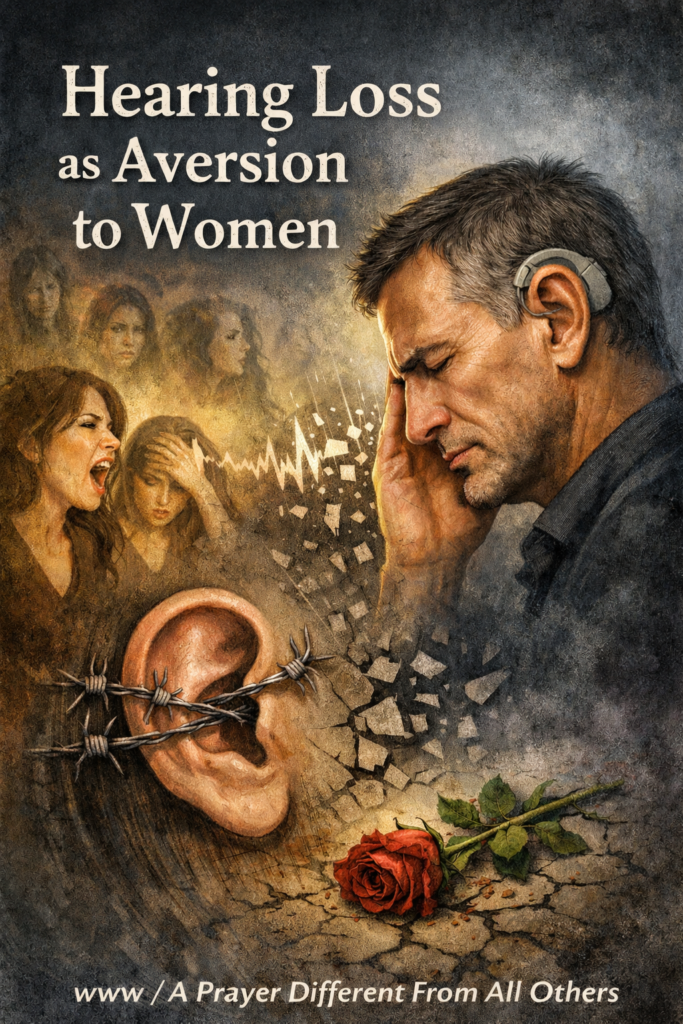
Hearing Loss (as aversion toward women) – intentions
Authors: J.S. Majda, Konrad Jaszowski, Małgorzata Krata, Adam Żak. The identical recurring fragment, forming the core of the idea, is as follows:“being those who, in the experience of sensorineural hearing loss, carry not only a physical limitation in perceiving high frequencies, but also relational patterns inscribed in deeper layers of existence connected with feminine energy, which may point to a history in which women’s voices were difficult to bear, painful, chaotic, or burdensome, and therefore required defense, distance, or withdrawal—both in personal relationships and in the broader ancestral context, where female emotions, fears, or unmet needs may have been experienced as excess, pressure, or lack of boundaries—leading to an unconscious mechanism of not-hearing as a form of protection, and to the consolidation of a pattern in which the soul learns survival through selective reception of the world, hearing what is lower, calmer, and more predictable, while cutting itself off from what is higher, changeable, and emotionally charged; which on a karmic level may reflect past experiences of conflict with women, unfinished relationships, guilt, loyalty to suffering mothers or women of the lineage, or resistance to receiving—not chatter, but feminine truth that demanded presence and response; which on a spiritual level reveals a tension between the need for control and the invitation to listen with the heart, resulting in the body taking over the function of a boundary, and hearing loss becoming the language of the soul saying, “this is too much for me,” until the moment this pattern is acknowledged without judgment; correspondingly being those who have sensorineural hearing loss as a real limitation of sound perception, especially in the range of high frequencies, resulting in difficulty understanding speech—particularly female and children’s voices—not due to lack of attention or willingness to listen, and accepting this experience as a burden inscribed in the body and nervous system, affecting relationships, communication, and one’s way of being in the world, sometimes leading to withdrawal, tension, and the need for constant vigilance, while simultaneously confronting the limits of one’s agency, which reveals coping patterns based on control, excessive focus, or silence, and shows how the body stores a history of limitation in which sound does not always reach fully and meaning must be reconstructed from fragments, giving rise to fatigue and a need for support; and acknowledging that hearing aids are technical tools but do not entirely remove the effects and causes of damage, therefore this process requires not only functional adaptation but also inner reconciliation with what is irreversible, without denial and without struggle, and offering to God the frustration, grief, and tension arising from living in a world that speaks quickly, loudly, and with many voices, while simultaneously opening to the truth that the value of the soul does not depend on the fullness of the senses, but on relationship—in which God receives this experience as a whole, heals what can be healed, and grants peace in what remains a limitation—bringing this process to completion in His presence across all dimensions and times”.
Organized freeing oneself from burdens – links to texts, information about recordings, working with intentions, the bow technique >Link.
Technical issues concerning the idea and the construction of sentences when working with intentions.
Art. “800 intentions for cleansing” Link.“One-sentence scheme for intentions.”Link.
Film “The bow after performing intentions” Link.
The word “–not” added to some word while working with intentions means that it is worth expressing it also in its opposite, or even finding and saying aloud any synonyms that come to mind together with their opposites. For example — when saying: being poor, being sick, it is good to say it also with its opposite:–being poor, being sick, –not being poor, not being sick. This allows you to move a given pattern as broadly as possible, touching different aspects, including its opposite. It is also worth knowing that Souls often think or claim that they do not have such opposite patterns — for example, that they are not idolaters in a given case (in a given word). Another example: A woman’s Soul denies ever being a bad mother. Therefore, adding here the negating form — not being a bad mother — may allow her to understand the state she is in. Being a bad mother, –not being a bad mother–“—Oh, absolutely not, never in my life! These are certainly not my patterns. What I do is my private matter.” [—The Soul very often says or thinks this about itself.]
1. of ours and through us of others, from all causes, in all ways, including being those who, in the experience of sensorineural hearing loss, carry not only a physical limitation in perceiving high frequencies, but also relational patterns inscribed in deeper layers of existence connected with feminine energy, which may point to a history in which women’s voices were difficult to bear, painful, chaotic, or burdensome, and therefore required defense, distance, or withdrawal—both in personal relationships and in the broader ancestral context, where female emotions, fears, or unmet needs may have been experienced as excess, pressure, or lack of boundaries—leading to an unconscious mechanism of not-hearing as a form of protection, and to the consolidation of a pattern in which the soul learns survival through selective reception of the world, hearing what is lower, calmer, and more predictable, while cutting itself off from what is higher, changeable, and emotionally charged; which on a karmic level may reflect past experiences of conflict with women, unfinished relationships, guilt, loyalty to suffering mothers or women of the lineage, or resistance to receiving—not chatter, but feminine truth that demanded presence and response; which on a spiritual level reveals a tension between the need for control and the invitation to listen with the heart, resulting in the body taking over the function of a boundary, and hearing loss becoming the language of the soul saying, “this is too much for me,” until the moment this pattern is acknowledged without judgment; correspondingly being those who have sensorineural hearing loss as a real limitation of sound perception, especially in the range of high frequencies, resulting in difficulty understanding speech—particularly female and children’s voices—not due to lack of attention or willingness to listen, and accepting this experience as a burden inscribed in the body and nervous system, affecting relationships, communication, and one’s way of being in the world, sometimes leading to withdrawal, tension, and the need for constant vigilance, while simultaneously confronting the limits of one’s agency, which reveals coping patterns based on control, excessive focus, or silence, and shows how the body stores a history of limitation in which sound does not always reach fully and meaning must be reconstructed from fragments, giving rise to fatigue and a need for support; and acknowledging that hearing aids are technical tools but do not entirely remove the effects and causes of damage, therefore this process requires not only functional adaptation but also inner reconciliation with what is irreversible, without denial and without struggle, and offering to God the frustration, grief, and tension arising from living in a world that speaks quickly, loudly, and with many voices, while simultaneously opening to the truth that the value of the soul does not depend on the fullness of the senses, but on relationship—in which God receives this experience as a whole, heals what can be healed, and grants peace in what remains a limitation—bringing this process to completion in His presence across all dimensions and times and not only, all of this depending and accordingly in independence from, among others, the will, guidelines, opinions, actions, trust, commands, resolutions, suggestions, inspirations, graces, generosity and accordingly their lack on the part of God Himself, and of ours and through us of others experiencing all the effects of this.
2. and of ours and through us of others, from all causes, in all ways, including being those who, in the experience of sensorineural hearing loss, carry not only a physical limitation in perceiving high frequencies, but also relational patterns inscribed in deeper layers of existence connected with feminine energy, which may point to a history in which women’s voices were difficult to bear, painful, chaotic, or burdensome, and therefore required defense, distance, or withdrawal—both in personal relationships and in the broader ancestral context, where female emotions, fears, or unmet needs may have been experienced as excess, pressure, or lack of boundaries—leading to an unconscious mechanism of not-hearing as a form of protection, and to the consolidation of a pattern in which the soul learns survival through selective reception of the world, hearing what is lower, calmer, and more predictable, while cutting itself off from what is higher, changeable, and emotionally charged; which on a karmic level may reflect past experiences of conflict with women, unfinished relationships, guilt, loyalty to suffering mothers or women of the lineage, or resistance to receiving—not chatter, but feminine truth that demanded presence and response; which on a spiritual level reveals a tension between the need for control and the invitation to listen with the heart, resulting in the body taking over the function of a boundary, and hearing loss becoming the language of the soul saying, “this is too much for me,” until the moment this pattern is acknowledged without judgment; correspondingly being those who have sensorineural hearing loss as a real limitation of sound perception, especially in the range of high frequencies, resulting in difficulty understanding speech—particularly female and children’s voices—not due to lack of attention or willingness to listen, and accepting this experience as a burden inscribed in the body and nervous system, affecting relationships, communication, and one’s way of being in the world, sometimes leading to withdrawal, tension, and the need for constant vigilance, while simultaneously confronting the limits of one’s agency, which reveals coping patterns based on control, excessive focus, or silence, and shows how the body stores a history of limitation in which sound does not always reach fully and meaning must be reconstructed from fragments, giving rise to fatigue and a need for support; and acknowledging that hearing aids are technical tools but do not entirely remove the effects and causes of damage, therefore this process requires not only functional adaptation but also inner reconciliation with what is irreversible, without denial and without struggle, and offering to God the frustration, grief, and tension arising from living in a world that speaks quickly, loudly, and with many voices, while simultaneously opening to the truth that the value of the soul does not depend on the fullness of the senses, but on relationship—in which God receives this experience as a whole, heals what can be healed, and grants peace in what remains a limitation—bringing this process to completion in His presence across all dimensions and times and not only, all of this depending and accordingly in independence from, among others, the will, guidelines, opinions, actions, commands, resolutions, suggestions, inspirations, graces, generosity and accordingly their lack on the part of all genders of humans, Souls, beings, entities, creations, animals, plants, extraterrestrials and not only, and of ours and through us of others experiencing all the effects of this.
3. and of ours and through us of others, from all causes, in all ways, including being those who, in the experience of sensorineural hearing loss, carry not only a physical limitation in perceiving high frequencies, but also relational patterns inscribed in deeper layers of existence connected with feminine energy, which may point to a history in which women’s voices were difficult to bear, painful, chaotic, or burdensome, and therefore required defense, distance, or withdrawal—both in personal relationships and in the broader ancestral context, where female emotions, fears, or unmet needs may have been experienced as excess, pressure, or lack of boundaries—leading to an unconscious mechanism of not-hearing as a form of protection, and to the consolidation of a pattern in which the soul learns survival through selective reception of the world, hearing what is lower, calmer, and more predictable, while cutting itself off from what is higher, changeable, and emotionally charged; which on a karmic level may reflect past experiences of conflict with women, unfinished relationships, guilt, loyalty to suffering mothers or women of the lineage, or resistance to receiving—not chatter, but feminine truth that demanded presence and response; which on a spiritual level reveals a tension between the need for control and the invitation to listen with the heart, resulting in the body taking over the function of a boundary, and hearing loss becoming the language of the soul saying, “this is too much for me,” until the moment this pattern is acknowledged without judgment; correspondingly being those who have sensorineural hearing loss as a real limitation of sound perception, especially in the range of high frequencies, resulting in difficulty understanding speech—particularly female and children’s voices—not due to lack of attention or willingness to listen, and accepting this experience as a burden inscribed in the body and nervous system, affecting relationships, communication, and one’s way of being in the world, sometimes leading to withdrawal, tension, and the need for constant vigilance, while simultaneously confronting the limits of one’s agency, which reveals coping patterns based on control, excessive focus, or silence, and shows how the body stores a history of limitation in which sound does not always reach fully and meaning must be reconstructed from fragments, giving rise to fatigue and a need for support; and acknowledging that hearing aids are technical tools but do not entirely remove the effects and causes of damage, therefore this process requires not only functional adaptation but also inner reconciliation with what is irreversible, without denial and without struggle, and offering to God the frustration, grief, and tension arising from living in a world that speaks quickly, loudly, and with many voices, while simultaneously opening to the truth that the value of the soul does not depend on the fullness of the senses, but on relationship—in which God receives this experience as a whole, heals what can be healed, and grants peace in what remains a limitation—bringing this process to completion in His presence across all dimensions and times and not only, all of this depending and accordingly in independence from, among others, the will, guidelines, opinions, actions, commands, resolutions, suggestions, inspirations, graces, generosity and accordingly their lack on the part of all kinds, meanings, species, genders including old and new, active and inactive deities, goddesses, divine mothers, divine fathers, divine sons, divine daughters, divine families, Goa’ulds, God’s buddies, gods, demigods, Asuras, Saints, gurus, masters, teachers, Messiahs, angels, including astral ones: Archangels, Cherubim, Seraphim, astrals, rulers, administrators, owners and creators of astral worlds and soul trees, prophets and not only, and of ours and through us of others experiencing all the effects of this.
4. and of ours and through us of others, from all causes, in all ways, including being those who, in the experience of sensorineural hearing loss, carry not only a physical limitation in perceiving high frequencies, but also relational patterns inscribed in deeper layers of existence connected with feminine energy, which may point to a history in which women’s voices were difficult to bear, painful, chaotic, or burdensome, and therefore required defense, distance, or withdrawal—both in personal relationships and in the broader ancestral context, where female emotions, fears, or unmet needs may have been experienced as excess, pressure, or lack of boundaries—leading to an unconscious mechanism of not-hearing as a form of protection, and to the consolidation of a pattern in which the soul learns survival through selective reception of the world, hearing what is lower, calmer, and more predictable, while cutting itself off from what is higher, changeable, and emotionally charged; which on a karmic level may reflect past experiences of conflict with women, unfinished relationships, guilt, loyalty to suffering mothers or women of the lineage, or resistance to receiving—not chatter, but feminine truth that demanded presence and response; which on a spiritual level reveals a tension between the need for control and the invitation to listen with the heart, resulting in the body taking over the function of a boundary, and hearing loss becoming the language of the soul saying, “this is too much for me,” until the moment this pattern is acknowledged without judgment; correspondingly being those who have sensorineural hearing loss as a real limitation of sound perception, especially in the range of high frequencies, resulting in difficulty understanding speech—particularly female and children’s voices—not due to lack of attention or willingness to listen, and accepting this experience as a burden inscribed in the body and nervous system, affecting relationships, communication, and one’s way of being in the world, sometimes leading to withdrawal, tension, and the need for constant vigilance, while simultaneously confronting the limits of one’s agency, which reveals coping patterns based on control, excessive focus, or silence, and shows how the body stores a history of limitation in which sound does not always reach fully and meaning must be reconstructed from fragments, giving rise to fatigue and a need for support; and acknowledging that hearing aids are technical tools but do not entirely remove the effects and causes of damage, therefore this process requires not only functional adaptation but also inner reconciliation with what is irreversible, without denial and without struggle, and offering to God the frustration, grief, and tension arising from living in a world that speaks quickly, loudly, and with many voices, while simultaneously opening to the truth that the value of the soul does not depend on the fullness of the senses, but on relationship—in which God receives this experience as a whole, heals what can be healed, and grants peace in what remains a limitation—bringing this process to completion in His presence across all dimensions and times and not only, all of this depending and accordingly in independence from, among others, the will, guidelines, opinions, actions, commands, resolutions, suggestions, inspirations, graces, generosity and accordingly their lack on the part of physical and astral snakes, worms, predators, viruses, pests, fungi, molds, insects, microorganisms and macroorganisms, lizards, beings, entities, creations, parasites, symbionts, tenants of our and others’ energy systems, and from all kinds of spirits, demons, strzygi, ancestral spirits, possessing beings, mythical creatures, mythical beings and not only, and of ours and through us of others experiencing all the effects of this.
5. and of ours and through us of others, from all causes, in all ways, including being those who, in the experience of sensorineural hearing loss, carry not only a physical limitation in perceiving high frequencies, but also relational patterns inscribed in deeper layers of existence connected with feminine energy, which may point to a history in which women’s voices were difficult to bear, painful, chaotic, or burdensome, and therefore required defense, distance, or withdrawal—both in personal relationships and in the broader ancestral context, where female emotions, fears, or unmet needs may have been experienced as excess, pressure, or lack of boundaries—leading to an unconscious mechanism of not-hearing as a form of protection, and to the consolidation of a pattern in which the soul learns survival through selective reception of the world, hearing what is lower, calmer, and more predictable, while cutting itself off from what is higher, changeable, and emotionally charged; which on a karmic level may reflect past experiences of conflict with women, unfinished relationships, guilt, loyalty to suffering mothers or women of the lineage, or resistance to receiving—not chatter, but feminine truth that demanded presence and response; which on a spiritual level reveals a tension between the need for control and the invitation to listen with the heart, resulting in the body taking over the function of a boundary, and hearing loss becoming the language of the soul saying, “this is too much for me,” until the moment this pattern is acknowledged without judgment; correspondingly being those who have sensorineural hearing loss as a real limitation of sound perception, especially in the range of high frequencies, resulting in difficulty understanding speech—particularly female and children’s voices—not due to lack of attention or willingness to listen, and accepting this experience as a burden inscribed in the body and nervous system, affecting relationships, communication, and one’s way of being in the world, sometimes leading to withdrawal, tension, and the need for constant vigilance, while simultaneously confronting the limits of one’s agency, which reveals coping patterns based on control, excessive focus, or silence, and shows how the body stores a history of limitation in which sound does not always reach fully and meaning must be reconstructed from fragments, giving rise to fatigue and a need for support; and acknowledging that hearing aids are technical tools but do not entirely remove the effects and causes of damage, therefore this process requires not only functional adaptation but also inner reconciliation with what is irreversible, without denial and without struggle, and offering to God the frustration, grief, and tension arising from living in a world that speaks quickly, loudly, and with many voices, while simultaneously opening to the truth that the value of the soul does not depend on the fullness of the senses, but on relationship—in which God receives this experience as a whole, heals what can be healed, and grants peace in what remains a limitation—bringing this process to completion in His presence across all dimensions and times and not only, all of this depending and accordingly in independence from, among others, the will, guidelines, opinions, actions, commands, resolutions, suggestions, inspirations, graces, generosity and accordingly their lack on the part of our and others’ miracle-workers, healers, folk healers, bioenergetic therapists, doctors of the body and Soul, from miraculous divine healings, from owners, administrators and structures of various initiatory practices including religious ones and Reiki, from witches, magicians, shamans, visionaries, oracles, from signs in the sky and on earth, from sorceresses, sorcerers, from magic, from the elements, yogis, tantrics, and not only, and of ours and through us of others experiencing all the effects of this.
6. and of ours and through us of others, from all causes, in all ways, including being those who, in the experience of sensorineural hearing loss, carry not only a physical limitation in perceiving high frequencies, but also relational patterns inscribed in deeper layers of existence connected with feminine energy, which may point to a history in which women’s voices were difficult to bear, painful, chaotic, or burdensome, and therefore required defense, distance, or withdrawal—both in personal relationships and in the broader ancestral context, where female emotions, fears, or unmet needs may have been experienced as excess, pressure, or lack of boundaries—leading to an unconscious mechanism of not-hearing as a form of protection, and to the consolidation of a pattern in which the soul learns survival through selective reception of the world, hearing what is lower, calmer, and more predictable, while cutting itself off from what is higher, changeable, and emotionally charged; which on a karmic level may reflect past experiences of conflict with women, unfinished relationships, guilt, loyalty to suffering mothers or women of the lineage, or resistance to receiving—not chatter, but feminine truth that demanded presence and response; which on a spiritual level reveals a tension between the need for control and the invitation to listen with the heart, resulting in the body taking over the function of a boundary, and hearing loss becoming the language of the soul saying, “this is too much for me,” until the moment this pattern is acknowledged without judgment; correspondingly being those who have sensorineural hearing loss as a real limitation of sound perception, especially in the range of high frequencies, resulting in difficulty understanding speech—particularly female and children’s voices—not due to lack of attention or willingness to listen, and accepting this experience as a burden inscribed in the body and nervous system, affecting relationships, communication, and one’s way of being in the world, sometimes leading to withdrawal, tension, and the need for constant vigilance, while simultaneously confronting the limits of one’s agency, which reveals coping patterns based on control, excessive focus, or silence, and shows how the body stores a history of limitation in which sound does not always reach fully and meaning must be reconstructed from fragments, giving rise to fatigue and a need for support; and acknowledging that hearing aids are technical tools but do not entirely remove the effects and causes of damage, therefore this process requires not only functional adaptation but also inner reconciliation with what is irreversible, without denial and without struggle, and offering to God the frustration, grief, and tension arising from living in a world that speaks quickly, loudly, and with many voices, while simultaneously opening to the truth that the value of the soul does not depend on the fullness of the senses, but on relationship—in which God receives this experience as a whole, heals what can be healed, and grants peace in what remains a limitation—bringing this process to completion in His presence across all dimensions and times and not only, all of this depending and accordingly in independence from, among others, the will, guidelines, opinions, actions, commands, resolutions, suggestions, inspirations, graces, generosity and accordingly their lack on the part of all kinds of enlightened ones, enlighteners, whiteners and accordingly blackeners of themselves and others, including humans, Souls, beings, parts of our and others’ Souls and beings, from those seeking nirvana, salvation, liberation, redemption and achieving them, from worshippers and creators of all astral compressions, all heavens, hells, paradises, purgatories, astral worlds and not only, and of ours and through us of others experiencing all the effects of this.
7. and of ours and through us of others, from all causes, in all ways, including being those who, in the experience of sensorineural hearing loss, carry not only a physical limitation in perceiving high frequencies, but also relational patterns inscribed in deeper layers of existence connected with feminine energy, which may point to a history in which women’s voices were difficult to bear, painful, chaotic, or burdensome, and therefore required defense, distance, or withdrawal—both in personal relationships and in the broader ancestral context, where female emotions, fears, or unmet needs may have been experienced as excess, pressure, or lack of boundaries—leading to an unconscious mechanism of not-hearing as a form of protection, and to the consolidation of a pattern in which the soul learns survival through selective reception of the world, hearing what is lower, calmer, and more predictable, while cutting itself off from what is higher, changeable, and emotionally charged; which on a karmic level may reflect past experiences of conflict with women, unfinished relationships, guilt, loyalty to suffering mothers or women of the lineage, or resistance to receiving—not chatter, but feminine truth that demanded presence and response; which on a spiritual level reveals a tension between the need for control and the invitation to listen with the heart, resulting in the body taking over the function of a boundary, and hearing loss becoming the language of the soul saying, “this is too much for me,” until the moment this pattern is acknowledged without judgment; correspondingly being those who have sensorineural hearing loss as a real limitation of sound perception, especially in the range of high frequencies, resulting in difficulty understanding speech—particularly female and children’s voices—not due to lack of attention or willingness to listen, and accepting this experience as a burden inscribed in the body and nervous system, affecting relationships, communication, and one’s way of being in the world, sometimes leading to withdrawal, tension, and the need for constant vigilance, while simultaneously confronting the limits of one’s agency, which reveals coping patterns based on control, excessive focus, or silence, and shows how the body stores a history of limitation in which sound does not always reach fully and meaning must be reconstructed from fragments, giving rise to fatigue and a need for support; and acknowledging that hearing aids are technical tools but do not entirely remove the effects and causes of damage, therefore this process requires not only functional adaptation but also inner reconciliation with what is irreversible, without denial and without struggle, and offering to God the frustration, grief, and tension arising from living in a world that speaks quickly, loudly, and with many voices, while simultaneously opening to the truth that the value of the soul does not depend on the fullness of the senses, but on relationship—in which God receives this experience as a whole, heals what can be healed, and grants peace in what remains a limitation—bringing this process to completion in His presence across all dimensions and times and not only, all of this depending and accordingly in independence from, among others, the will, guidelines, opinions, actions, commands, resolutions, suggestions, inspirations, graces, generosity and accordingly their lack on the part of all atheists, agnostics, heretics, followers of Bahá’í, tribal religions, polytheism, animism, totemism, Taoism, Shinto, Sikhism, Jainism, Ahimsa, Ayyavazhi, followers of Wicca, followers of Buddhism, Druidism, Voodoo, Theravada, Mahayana, Chan, Zen, Son, Amidism, Pure Land School, Tendai, Shingon, Tibetan Buddhism, Nyingma, Kagyu, Sakya, Jonang, Gelug, Bon and not only, and on the part of their priests, creators, followers, promoters and not only, and of ours and through us of others experiencing all the effects of this.
8. and of ours and through us of others, from all causes, in all ways, including being those who, in the experience of sensorineural hearing loss, carry not only a physical limitation in perceiving high frequencies, but also relational patterns inscribed in deeper layers of existence connected with feminine energy, which may point to a history in which women’s voices were difficult to bear, painful, chaotic, or burdensome, and therefore required defense, distance, or withdrawal—both in personal relationships and in the broader ancestral context, where female emotions, fears, or unmet needs may have been experienced as excess, pressure, or lack of boundaries—leading to an unconscious mechanism of not-hearing as a form of protection, and to the consolidation of a pattern in which the soul learns survival through selective reception of the world, hearing what is lower, calmer, and more predictable, while cutting itself off from what is higher, changeable, and emotionally charged; which on a karmic level may reflect past experiences of conflict with women, unfinished relationships, guilt, loyalty to suffering mothers or women of the lineage, or resistance to receiving—not chatter, but feminine truth that demanded presence and response; which on a spiritual level reveals a tension between the need for control and the invitation to listen with the heart, resulting in the body taking over the function of a boundary, and hearing loss becoming the language of the soul saying, “this is too much for me,” until the moment this pattern is acknowledged without judgment; correspondingly being those who have sensorineural hearing loss as a real limitation of sound perception, especially in the range of high frequencies, resulting in difficulty understanding speech—particularly female and children’s voices—not due to lack of attention or willingness to listen, and accepting this experience as a burden inscribed in the body and nervous system, affecting relationships, communication, and one’s way of being in the world, sometimes leading to withdrawal, tension, and the need for constant vigilance, while simultaneously confronting the limits of one’s agency, which reveals coping patterns based on control, excessive focus, or silence, and shows how the body stores a history of limitation in which sound does not always reach fully and meaning must be reconstructed from fragments, giving rise to fatigue and a need for support; and acknowledging that hearing aids are technical tools but do not entirely remove the effects and causes of damage, therefore this process requires not only functional adaptation but also inner reconciliation with what is irreversible, without denial and without struggle, and offering to God the frustration, grief, and tension arising from living in a world that speaks quickly, loudly, and with many voices, while simultaneously opening to the truth that the value of the soul does not depend on the fullness of the senses, but on relationship—in which God receives this experience as a whole, heals what can be healed, and grants peace in what remains a limitation—bringing this process to completion in His presence across all dimensions and times and not only, all of this depending and accordingly in independence from, among others, the will, guidelines, opinions, actions, commands, resolutions, suggestions, inspirations, graces, generosity and accordingly their lack on the part of Jesus, the Apostles, the Church Fathers, All Saints, the Lord’s Prayer, the Holy Spirit, as well as followers, creators, priests and administrators of all Christian sects including Old Catholicism, Utrecht churches, national churches, Mariavitism, Catholicism, Eastern Catholicism, Greek Catholicism, the Roman Catholic Church, Sedevacantism, Conclavism, Palmarianism, Lefebvrism, Anglicanism, Orthodoxy, Byzantine churches, Orthodox churches, Old Believers, Popovtsy, Bespopovtsy, Skoptsy, Old Calendarists, Oriental churches, Copts, Syrians, Assyrian churches, Adventists, Millerism, Anabaptism, followers of Arianism, Baptists, Moravian Brethren, Polymuck Brothers, Hussites, Calvinism, Congregationalism, Presbyterianism, Quakers, Lutheranism, Mennonitism, Methodism, Pentecostalism, Salvationism, Unitarianism, Waldensians, Amish, Restorationism, Bábism, Jehovah’s Witnesses, Free Bible Students, Holy Missionary Movements, Unitarians, Mormons, Churches of Jesus Christ of Latter-day Saints, Christ Community, Afro-Christianity such as Aladura, Harrism, Kimbanguism, Lumba and not only, and of ours and through us of others experiencing all the effects of this.
9. and of ours and through us of others, from all causes, in all ways, including being those who, in the experience of sensorineural hearing loss, carry not only a physical limitation in perceiving high frequencies, but also relational patterns inscribed in deeper layers of existence connected with feminine energy, which may point to a history in which women’s voices were difficult to bear, painful, chaotic, or burdensome, and therefore required defense, distance, or withdrawal—both in personal relationships and in the broader ancestral context, where female emotions, fears, or unmet needs may have been experienced as excess, pressure, or lack of boundaries—leading to an unconscious mechanism of not-hearing as a form of protection, and to the consolidation of a pattern in which the soul learns survival through selective reception of the world, hearing what is lower, calmer, and more predictable, while cutting itself off from what is higher, changeable, and emotionally charged; which on a karmic level may reflect past experiences of conflict with women, unfinished relationships, guilt, loyalty to suffering mothers or women of the lineage, or resistance to receiving—not chatter, but feminine truth that demanded presence and response; which on a spiritual level reveals a tension between the need for control and the invitation to listen with the heart, resulting in the body taking over the function of a boundary, and hearing loss becoming the language of the soul saying, “this is too much for me,” until the moment this pattern is acknowledged without judgment; correspondingly being those who have sensorineural hearing loss as a real limitation of sound perception, especially in the range of high frequencies, resulting in difficulty understanding speech—particularly female and children’s voices—not due to lack of attention or willingness to listen, and accepting this experience as a burden inscribed in the body and nervous system, affecting relationships, communication, and one’s way of being in the world, sometimes leading to withdrawal, tension, and the need for constant vigilance, while simultaneously confronting the limits of one’s agency, which reveals coping patterns based on control, excessive focus, or silence, and shows how the body stores a history of limitation in which sound does not always reach fully and meaning must be reconstructed from fragments, giving rise to fatigue and a need for support; and acknowledging that hearing aids are technical tools but do not entirely remove the effects and causes of damage, therefore this process requires not only functional adaptation but also inner reconciliation with what is irreversible, without denial and without struggle, and offering to God the frustration, grief, and tension arising from living in a world that speaks quickly, loudly, and with many voices, while simultaneously opening to the truth that the value of the soul does not depend on the fullness of the senses, but on relationship—in which God receives this experience as a whole, heals what can be healed, and grants peace in what remains a limitation—bringing this process to completion in His presence across all dimensions and times and not only, all of this depending and accordingly in independence from, among others, the will, guidelines, opinions, actions, commands, resolutions, suggestions, inspirations, graces, generosity and accordingly their lack on the part of, among others, followers, creators, priests and administrators of, among others, Jainism, Digambaras, Sthanakavasis, Shvetambaras, Gnostics, followers of Manichaeism, Mandaeism, from all branches and sects of Vishnu, Vishnuism, Krishnaism, Shaivism, Lingayats, Shaktism, Mazdaism, Persian religions, Mazdakism, Mithraism and not only, and of ours and through us of others experiencing all the effects of this.
10. and of ours and through us of others, from all causes, in all ways, including being those who, in the experience of sensorineural hearing loss, carry not only a physical limitation in perceiving high frequencies, but also relational patterns inscribed in deeper layers of existence connected with feminine energy, which may point to a history in which women’s voices were difficult to bear, painful, chaotic, or burdensome, and therefore required defense, distance, or withdrawal—both in personal relationships and in the broader ancestral context, where female emotions, fears, or unmet needs may have been experienced as excess, pressure, or lack of boundaries—leading to an unconscious mechanism of not-hearing as a form of protection, and to the consolidation of a pattern in which the soul learns survival through selective reception of the world, hearing what is lower, calmer, and more predictable, while cutting itself off from what is higher, changeable, and emotionally charged; which on a karmic level may reflect past experiences of conflict with women, unfinished relationships, guilt, loyalty to suffering mothers or women of the lineage, or resistance to receiving—not chatter, but feminine truth that demanded presence and response; which on a spiritual level reveals a tension between the need for control and the invitation to listen with the heart, resulting in the body taking over the function of a boundary, and hearing loss becoming the language of the soul saying, “this is too much for me,” until the moment this pattern is acknowledged without judgment; correspondingly being those who have sensorineural hearing loss as a real limitation of sound perception, especially in the range of high frequencies, resulting in difficulty understanding speech—particularly female and children’s voices—not due to lack of attention or willingness to listen, and accepting this experience as a burden inscribed in the body and nervous system, affecting relationships, communication, and one’s way of being in the world, sometimes leading to withdrawal, tension, and the need for constant vigilance, while simultaneously confronting the limits of one’s agency, which reveals coping patterns based on control, excessive focus, or silence, and shows how the body stores a history of limitation in which sound does not always reach fully and meaning must be reconstructed from fragments, giving rise to fatigue and a need for support; and acknowledging that hearing aids are technical tools but do not entirely remove the effects and causes of damage, therefore this process requires not only functional adaptation but also inner reconciliation with what is irreversible, without denial and without struggle, and offering to God the frustration, grief, and tension arising from living in a world that speaks quickly, loudly, and with many voices, while simultaneously opening to the truth that the value of the soul does not depend on the fullness of the senses, but on relationship—in which God receives this experience as a whole, heals what can be healed, and grants peace in what remains a limitation—bringing this process to completion in His presence across all dimensions and times and not only, all of this depending and accordingly in independence from, among others, the will, guidelines, opinions, actions, commands, resolutions, suggestions, inspirations, graces, generosity and accordingly their lack on the part of the followers, creators, priests and administrators of the world of Islam, among others Alawites, Alevis, Kharijites, Sunnis, Shiites, Imamis, Ismailis, Zaydis, followers of Sufism, Ahmadiyya, black Islam, Moors, Nation of Islam, Druze, Ahl-e-Haqq, Zikris, Scripturalism, Quranism, Yazidism and not only, and of ours and through us of others experiencing all the effects of this.
11. and of ours and through us of others, from all causes, in all ways, including being those who, in the experience of sensorineural hearing loss, carry not only a physical limitation in perceiving high frequencies, but also relational patterns inscribed in deeper layers of existence connected with feminine energy, which may point to a history in which women’s voices were difficult to bear, painful, chaotic, or burdensome, and therefore required defense, distance, or withdrawal—both in personal relationships and in the broader ancestral context, where female emotions, fears, or unmet needs may have been experienced as excess, pressure, or lack of boundaries—leading to an unconscious mechanism of not-hearing as a form of protection, and to the consolidation of a pattern in which the soul learns survival through selective reception of the world, hearing what is lower, calmer, and more predictable, while cutting itself off from what is higher, changeable, and emotionally charged; which on a karmic level may reflect past experiences of conflict with women, unfinished relationships, guilt, loyalty to suffering mothers or women of the lineage, or resistance to receiving—not chatter, but feminine truth that demanded presence and response; which on a spiritual level reveals a tension between the need for control and the invitation to listen with the heart, resulting in the body taking over the function of a boundary, and hearing loss becoming the language of the soul saying, “this is too much for me,” until the moment this pattern is acknowledged without judgment; correspondingly being those who have sensorineural hearing loss as a real limitation of sound perception, especially in the range of high frequencies, resulting in difficulty understanding speech—particularly female and children’s voices—not due to lack of attention or willingness to listen, and accepting this experience as a burden inscribed in the body and nervous system, affecting relationships, communication, and one’s way of being in the world, sometimes leading to withdrawal, tension, and the need for constant vigilance, while simultaneously confronting the limits of one’s agency, which reveals coping patterns based on control, excessive focus, or silence, and shows how the body stores a history of limitation in which sound does not always reach fully and meaning must be reconstructed from fragments, giving rise to fatigue and a need for support; and acknowledging that hearing aids are technical tools but do not entirely remove the effects and causes of damage, therefore this process requires not only functional adaptation but also inner reconciliation with what is irreversible, without denial and without struggle, and offering to God the frustration, grief, and tension arising from living in a world that speaks quickly, loudly, and with many voices, while simultaneously opening to the truth that the value of the soul does not depend on the fullness of the senses, but on relationship—in which God receives this experience as a whole, heals what can be healed, and grants peace in what remains a limitation—bringing this process to completion in His presence across all dimensions and times and not only, all of this depending and accordingly in independence from, among others, the will, guidelines, opinions, actions, commands, resolutions, suggestions, inspirations, graces, generosity and accordingly their lack on the part of, among others, promoters, creators, priests and followers of all sects and factions of Judaism: among others, Falashas called black Jews, Messianic Judaism including Hasidic, Conservative Judaism, Orthodox, Progressive, Reconstructionist, Karaimism, Mosaism, Samaritanism and not only, and of ours and through us of others experiencing all the effects of this.
12. and of ours and through us of others, from all causes, in all ways, including being those who, in the experience of sensorineural hearing loss, carry not only a physical limitation in perceiving high frequencies, but also relational patterns inscribed in deeper layers of existence connected with feminine energy, which may point to a history in which women’s voices were difficult to bear, painful, chaotic, or burdensome, and therefore required defense, distance, or withdrawal—both in personal relationships and in the broader ancestral context, where female emotions, fears, or unmet needs may have been experienced as excess, pressure, or lack of boundaries—leading to an unconscious mechanism of not-hearing as a form of protection, and to the consolidation of a pattern in which the soul learns survival through selective reception of the world, hearing what is lower, calmer, and more predictable, while cutting itself off from what is higher, changeable, and emotionally charged; which on a karmic level may reflect past experiences of conflict with women, unfinished relationships, guilt, loyalty to suffering mothers or women of the lineage, or resistance to receiving—not chatter, but feminine truth that demanded presence and response; which on a spiritual level reveals a tension between the need for control and the invitation to listen with the heart, resulting in the body taking over the function of a boundary, and hearing loss becoming the language of the soul saying, “this is too much for me,” until the moment this pattern is acknowledged without judgment; correspondingly being those who have sensorineural hearing loss as a real limitation of sound perception, especially in the range of high frequencies, resulting in difficulty understanding speech—particularly female and children’s voices—not due to lack of attention or willingness to listen, and accepting this experience as a burden inscribed in the body and nervous system, affecting relationships, communication, and one’s way of being in the world, sometimes leading to withdrawal, tension, and the need for constant vigilance, while simultaneously confronting the limits of one’s agency, which reveals coping patterns based on control, excessive focus, or silence, and shows how the body stores a history of limitation in which sound does not always reach fully and meaning must be reconstructed from fragments, giving rise to fatigue and a need for support; and acknowledging that hearing aids are technical tools but do not entirely remove the effects and causes of damage, therefore this process requires not only functional adaptation but also inner reconciliation with what is irreversible, without denial and without struggle, and offering to God the frustration, grief, and tension arising from living in a world that speaks quickly, loudly, and with many voices, while simultaneously opening to the truth that the value of the soul does not depend on the fullness of the senses, but on relationship—in which God receives this experience as a whole, heals what can be healed, and grants peace in what remains a limitation—bringing this process to completion in His presence across all dimensions and times and not only, all of this depending and accordingly in independence from, among others, the will, guidelines, opinions, actions, commands, resolutions, suggestions, inspirations, graces, generosity and accordingly their lack on the part of, among others, creators, organizers, administrators and followers of the so-called new religious movements such as Bábism, Bahá’í, Cheondoism, Caodaism, Shakers, cargo cults, Falun Gong, Modekngei, New Age, Raëlism, Rastafari, Scientology, Quan Yin Method, Wicca, “I Am”, Ásatrú, Hellenism, Slavic native faith, International Intelligent Yoga, Transcendental Meditation, Divine Light Mission, International Society for Krishna Consciousness, Neo-Sannyas (Osho), Radha Soami, Sathya Sai Baba, Swaminarayan Faith, Harrism, Confucianism, Santería, Sikhism, Shinto, Taoism, Zoroastrianism and not only, and of ours and through us of others experiencing all the effects of this.
13. and of ours and through us of others, from all causes, in all ways, including being those who, in the experience of sensorineural hearing loss, carry not only a physical limitation in perceiving high frequencies, but also relational patterns inscribed in deeper layers of existence connected with feminine energy, which may point to a history in which women’s voices were difficult to bear, painful, chaotic, or burdensome, and therefore required defense, distance, or withdrawal—both in personal relationships and in the broader ancestral context, where female emotions, fears, or unmet needs may have been experienced as excess, pressure, or lack of boundaries—leading to an unconscious mechanism of not-hearing as a form of protection, and to the consolidation of a pattern in which the soul learns survival through selective reception of the world, hearing what is lower, calmer, and more predictable, while cutting itself off from what is higher, changeable, and emotionally charged; which on a karmic level may reflect past experiences of conflict with women, unfinished relationships, guilt, loyalty to suffering mothers or women of the lineage, or resistance to receiving—not chatter, but feminine truth that demanded presence and response; which on a spiritual level reveals a tension between the need for control and the invitation to listen with the heart, resulting in the body taking over the function of a boundary, and hearing loss becoming the language of the soul saying, “this is too much for me,” until the moment this pattern is acknowledged without judgment; correspondingly being those who have sensorineural hearing loss as a real limitation of sound perception, especially in the range of high frequencies, resulting in difficulty understanding speech—particularly female and children’s voices—not due to lack of attention or willingness to listen, and accepting this experience as a burden inscribed in the body and nervous system, affecting relationships, communication, and one’s way of being in the world, sometimes leading to withdrawal, tension, and the need for constant vigilance, while simultaneously confronting the limits of one’s agency, which reveals coping patterns based on control, excessive focus, or silence, and shows how the body stores a history of limitation in which sound does not always reach fully and meaning must be reconstructed from fragments, giving rise to fatigue and a need for support; and acknowledging that hearing aids are technical tools but do not entirely remove the effects and causes of damage, therefore this process requires not only functional adaptation but also inner reconciliation with what is irreversible, without denial and without struggle, and offering to God the frustration, grief, and tension arising from living in a world that speaks quickly, loudly, and with many voices, while simultaneously opening to the truth that the value of the soul does not depend on the fullness of the senses, but on relationship—in which God receives this experience as a whole, heals what can be healed, and grants peace in what remains a limitation—bringing this process to completion in His presence across all dimensions and times and not only, all of this depending and accordingly in independence from, among others, the will, guidelines, opinions, actions, commands, resolutions, suggestions, inspirations, graces, generosity and accordingly their lack on the part of the promoters, creators, priests and followers of all sects and factions, among others, of religions and of the inhabitants of Supercontinents, continents and prehistoric lands such as, among others, Pangaea, Gondwana, Atlantis, Lemuria, Mu, Gobi, native religions of Africa, Australia, Oceania, Asia, Europe, the Americas and other places on Earth, and not only, and of ours and through us of others experiencing all the effects of this.
14. and of ours and through us of others, from all causes, in all ways, including being those who, in the experience of sensorineural hearing loss, carry not only a physical limitation in perceiving high frequencies, but also relational patterns inscribed in deeper layers of existence connected with feminine energy, which may point to a history in which women’s voices were difficult to bear, painful, chaotic, or burdensome, and therefore required defense, distance, or withdrawal—both in personal relationships and in the broader ancestral context, where female emotions, fears, or unmet needs may have been experienced as excess, pressure, or lack of boundaries—leading to an unconscious mechanism of not-hearing as a form of protection, and to the consolidation of a pattern in which the soul learns survival through selective reception of the world, hearing what is lower, calmer, and more predictable, while cutting itself off from what is higher, changeable, and emotionally charged; which on a karmic level may reflect past experiences of conflict with women, unfinished relationships, guilt, loyalty to suffering mothers or women of the lineage, or resistance to receiving—not chatter, but feminine truth that demanded presence and response; which on a spiritual level reveals a tension between the need for control and the invitation to listen with the heart, resulting in the body taking over the function of a boundary, and hearing loss becoming the language of the soul saying, “this is too much for me,” until the moment this pattern is acknowledged without judgment; correspondingly being those who have sensorineural hearing loss as a real limitation of sound perception, especially in the range of high frequencies, resulting in difficulty understanding speech—particularly female and children’s voices—not due to lack of attention or willingness to listen, and accepting this experience as a burden inscribed in the body and nervous system, affecting relationships, communication, and one’s way of being in the world, sometimes leading to withdrawal, tension, and the need for constant vigilance, while simultaneously confronting the limits of one’s agency, which reveals coping patterns based on control, excessive focus, or silence, and shows how the body stores a history of limitation in which sound does not always reach fully and meaning must be reconstructed from fragments, giving rise to fatigue and a need for support; and acknowledging that hearing aids are technical tools but do not entirely remove the effects and causes of damage, therefore this process requires not only functional adaptation but also inner reconciliation with what is irreversible, without denial and without struggle, and offering to God the frustration, grief, and tension arising from living in a world that speaks quickly, loudly, and with many voices, while simultaneously opening to the truth that the value of the soul does not depend on the fullness of the senses, but on relationship—in which God receives this experience as a whole, heals what can be healed, and grants peace in what remains a limitation—bringing this process to completion in His presence across all dimensions and times and not only, all of this depending and accordingly in independence from, among others, the will, guidelines, opinions, actions, commands, resolutions, suggestions, inspirations, graces, generosity and accordingly their lack on the part of, among others, all kinds of tyrants, despots, sociopaths, executioners, terrorists, blackmailers, judges, lawyers, prosecutors, accusers, lords, rulers, superiors, supervisors, employers, co-workers, clients, payers, manipulators, hypnotists, kings, princes, courts, advisers, messengers, notaries, secretaries, state power, religious power, and on the part of all creators and promoters of various destructive inventions and practices including such as injected substances, viruses, parasites, bio-robots, artefacts, such as games and plays like Jumanji, Infinity Stones, Rings of Power and not only, and of ours and through us of others experiencing all the effects of this.
15. and of ours and through us of others, from all causes, in all ways, including being those who, in the experience of sensorineural hearing loss, carry not only a physical limitation in perceiving high frequencies, but also relational patterns inscribed in deeper layers of existence connected with feminine energy, which may point to a history in which women’s voices were difficult to bear, painful, chaotic, or burdensome, and therefore required defense, distance, or withdrawal—both in personal relationships and in the broader ancestral context, where female emotions, fears, or unmet needs may have been experienced as excess, pressure, or lack of boundaries—leading to an unconscious mechanism of not-hearing as a form of protection, and to the consolidation of a pattern in which the soul learns survival through selective reception of the world, hearing what is lower, calmer, and more predictable, while cutting itself off from what is higher, changeable, and emotionally charged; which on a karmic level may reflect past experiences of conflict with women, unfinished relationships, guilt, loyalty to suffering mothers or women of the lineage, or resistance to receiving—not chatter, but feminine truth that demanded presence and response; which on a spiritual level reveals a tension between the need for control and the invitation to listen with the heart, resulting in the body taking over the function of a boundary, and hearing loss becoming the language of the soul saying, “this is too much for me,” until the moment this pattern is acknowledged without judgment; correspondingly being those who have sensorineural hearing loss as a real limitation of sound perception, especially in the range of high frequencies, resulting in difficulty understanding speech—particularly female and children’s voices—not due to lack of attention or willingness to listen, and accepting this experience as a burden inscribed in the body and nervous system, affecting relationships, communication, and one’s way of being in the world, sometimes leading to withdrawal, tension, and the need for constant vigilance, while simultaneously confronting the limits of one’s agency, which reveals coping patterns based on control, excessive focus, or silence, and shows how the body stores a history of limitation in which sound does not always reach fully and meaning must be reconstructed from fragments, giving rise to fatigue and a need for support; and acknowledging that hearing aids are technical tools but do not entirely remove the effects and causes of damage, therefore this process requires not only functional adaptation but also inner reconciliation with what is irreversible, without denial and without struggle, and offering to God the frustration, grief, and tension arising from living in a world that speaks quickly, loudly, and with many voices, while simultaneously opening to the truth that the value of the soul does not depend on the fullness of the senses, but on relationship—in which God receives this experience as a whole, heals what can be healed, and grants peace in what remains a limitation—bringing this process to completion in His presence across all dimensions and times and not only, all of this depending and accordingly in independence from, among others, the will, guidelines, opinions, actions, commands, resolutions, suggestions, inspirations, graces, generosity and accordingly their lack on the part of, among others, all planets, constellations, cosmos, stars, moons, comets, asteroids, galaxies, cosmic dust, black holes, suns, celestial bodies, from their movements, positions, interactions, and from all their, among others, owners, administrators, creators, tenants, users and not only, and of ours and through us of others experiencing all the effects of this.
16. and of ours and through us of others, from all causes, in all ways, including being those who, in the experience of sensorineural hearing loss, carry not only a physical limitation in perceiving high frequencies, but also relational patterns inscribed in deeper layers of existence connected with feminine energy, which may point to a history in which women’s voices were difficult to bear, painful, chaotic, or burdensome, and therefore required defense, distance, or withdrawal—both in personal relationships and in the broader ancestral context, where female emotions, fears, or unmet needs may have been experienced as excess, pressure, or lack of boundaries—leading to an unconscious mechanism of not-hearing as a form of protection, and to the consolidation of a pattern in which the soul learns survival through selective reception of the world, hearing what is lower, calmer, and more predictable, while cutting itself off from what is higher, changeable, and emotionally charged; which on a karmic level may reflect past experiences of conflict with women, unfinished relationships, guilt, loyalty to suffering mothers or women of the lineage, or resistance to receiving—not chatter, but feminine truth that demanded presence and response; which on a spiritual level reveals a tension between the need for control and the invitation to listen with the heart, resulting in the body taking over the function of a boundary, and hearing loss becoming the language of the soul saying, “this is too much for me,” until the moment this pattern is acknowledged without judgment; correspondingly being those who have sensorineural hearing loss as a real limitation of sound perception, especially in the range of high frequencies, resulting in difficulty understanding speech—particularly female and children’s voices—not due to lack of attention or willingness to listen, and accepting this experience as a burden inscribed in the body and nervous system, affecting relationships, communication, and one’s way of being in the world, sometimes leading to withdrawal, tension, and the need for constant vigilance, while simultaneously confronting the limits of one’s agency, which reveals coping patterns based on control, excessive focus, or silence, and shows how the body stores a history of limitation in which sound does not always reach fully and meaning must be reconstructed from fragments, giving rise to fatigue and a need for support; and acknowledging that hearing aids are technical tools but do not entirely remove the effects and causes of damage, therefore this process requires not only functional adaptation but also inner reconciliation with what is irreversible, without denial and without struggle, and offering to God the frustration, grief, and tension arising from living in a world that speaks quickly, loudly, and with many voices, while simultaneously opening to the truth that the value of the soul does not depend on the fullness of the senses, but on relationship—in which God receives this experience as a whole, heals what can be healed, and grants peace in what remains a limitation—bringing this process to completion in His presence across all dimensions and times and not only, all of this depending and accordingly in independence from, among others, the will, guidelines, opinions, actions, commands, resolutions, suggestions, inspirations, graces, generosity and accordingly their lack on the part of all kinds, sizes, meanings of ours and others’ amulets, talismans, garments, artefacts, gadgets, objects and plasma, musical, magical and non-magical instruments, from rings, seals, wands, elixirs, herbs, smokes, incenses, songs, mantras, Holy texts, plants, animals, methods of divination, rituals, superstitions, from Holy Communion, from offerings made to someone/something, devotional articles, images, figures, sculptures, paintings, sacraments, drugs, alcohols, spiritual and physical ecstasies, shamanism, mysticism, all utopias and not only, and from, among others, all their creators, promoters, owners, users, beneficiaries, and not only, and of ours and through us of others experiencing all the effects of this.
17. and of ours and through us of others, from all causes, in all ways, including being those who, in the experience of sensorineural hearing loss, carry not only a physical limitation in perceiving high frequencies, but also relational patterns inscribed in deeper layers of existence connected with feminine energy, which may point to a history in which women’s voices were difficult to bear, painful, chaotic, or burdensome, and therefore required defense, distance, or withdrawal—both in personal relationships and in the broader ancestral context, where female emotions, fears, or unmet needs may have been experienced as excess, pressure, or lack of boundaries—leading to an unconscious mechanism of not-hearing as a form of protection, and to the consolidation of a pattern in which the soul learns survival through selective reception of the world, hearing what is lower, calmer, and more predictable, while cutting itself off from what is higher, changeable, and emotionally charged; which on a karmic level may reflect past experiences of conflict with women, unfinished relationships, guilt, loyalty to suffering mothers or women of the lineage, or resistance to receiving—not chatter, but feminine truth that demanded presence and response; which on a spiritual level reveals a tension between the need for control and the invitation to listen with the heart, resulting in the body taking over the function of a boundary, and hearing loss becoming the language of the soul saying, “this is too much for me,” until the moment this pattern is acknowledged without judgment; correspondingly being those who have sensorineural hearing loss as a real limitation of sound perception, especially in the range of high frequencies, resulting in difficulty understanding speech—particularly female and children’s voices—not due to lack of attention or willingness to listen, and accepting this experience as a burden inscribed in the body and nervous system, affecting relationships, communication, and one’s way of being in the world, sometimes leading to withdrawal, tension, and the need for constant vigilance, while simultaneously confronting the limits of one’s agency, which reveals coping patterns based on control, excessive focus, or silence, and shows how the body stores a history of limitation in which sound does not always reach fully and meaning must be reconstructed from fragments, giving rise to fatigue and a need for support; and acknowledging that hearing aids are technical tools but do not entirely remove the effects and causes of damage, therefore this process requires not only functional adaptation but also inner reconciliation with what is irreversible, without denial and without struggle, and offering to God the frustration, grief, and tension arising from living in a world that speaks quickly, loudly, and with many voices, while simultaneously opening to the truth that the value of the soul does not depend on the fullness of the senses, but on relationship—in which God receives this experience as a whole, heals what can be healed, and grants peace in what remains a limitation—bringing this process to completion in His presence across all dimensions and times and not only, all of this depending and accordingly in independence from, among others, the will, guidelines, opinions, actions, commands, resolutions, suggestions, inspirations, graces, generosity and accordingly their lack on the part of all kinds, sizes, meanings of, among others, all forms and causes of enslavements, imprisonments, entanglements such as, among others, nets, ropes, chains, leashes, collars, solitary cells, prisons, cages, hooks, stocks, little octopuses, pyramids, protomolecules, their equivalents, substitutes and not only, and all their, among others, enthusiasts, creators, promoters, beneficiaries, victims, guards, witnesses and followers and not only, and of ours and through us of others experiencing all the effects of this.
18. and of ours and through us of others, from all causes, in all ways, including being those who, in the experience of sensorineural hearing loss, carry not only a physical limitation in perceiving high frequencies, but also relational patterns inscribed in deeper layers of existence connected with feminine energy, which may point to a history in which women’s voices were difficult to bear, painful, chaotic, or burdensome, and therefore required defense, distance, or withdrawal—both in personal relationships and in the broader ancestral context, where female emotions, fears, or unmet needs may have been experienced as excess, pressure, or lack of boundaries—leading to an unconscious mechanism of not-hearing as a form of protection, and to the consolidation of a pattern in which the soul learns survival through selective reception of the world, hearing what is lower, calmer, and more predictable, while cutting itself off from what is higher, changeable, and emotionally charged; which on a karmic level may reflect past experiences of conflict with women, unfinished relationships, guilt, loyalty to suffering mothers or women of the lineage, or resistance to receiving—not chatter, but feminine truth that demanded presence and response; which on a spiritual level reveals a tension between the need for control and the invitation to listen with the heart, resulting in the body taking over the function of a boundary, and hearing loss becoming the language of the soul saying, “this is too much for me,” until the moment this pattern is acknowledged without judgment; correspondingly being those who have sensorineural hearing loss as a real limitation of sound perception, especially in the range of high frequencies, resulting in difficulty understanding speech—particularly female and children’s voices—not due to lack of attention or willingness to listen, and accepting this experience as a burden inscribed in the body and nervous system, affecting relationships, communication, and one’s way of being in the world, sometimes leading to withdrawal, tension, and the need for constant vigilance, while simultaneously confronting the limits of one’s agency, which reveals coping patterns based on control, excessive focus, or silence, and shows how the body stores a history of limitation in which sound does not always reach fully and meaning must be reconstructed from fragments, giving rise to fatigue and a need for support; and acknowledging that hearing aids are technical tools but do not entirely remove the effects and causes of damage, therefore this process requires not only functional adaptation but also inner reconciliation with what is irreversible, without denial and without struggle, and offering to God the frustration, grief, and tension arising from living in a world that speaks quickly, loudly, and with many voices, while simultaneously opening to the truth that the value of the soul does not depend on the fullness of the senses, but on relationship—in which God receives this experience as a whole, heals what can be healed, and grants peace in what remains a limitation—bringing this process to completion in His presence across all dimensions and times and not only, all of this depending and accordingly in independence from, among others, the will, guidelines, opinions, actions, commands, resolutions, suggestions, inspirations, graces, generosity and accordingly their lack on the part of all kinds and sizes of, among others, rituals, cults, nominations, anointings, permissions, guidelines, contracts, oaths, promises, covenants, orders, prohibitions, pacts signed with the devil, missions, vows, pacts, acts, agreements, treaties and not only, and of all their, among others, creators, promoters, beneficiaries, priests, guards, victims, witnesses and followers and not only, and of ours and through us of others experiencing all the effects of this.
19. and of ours and through us of others, from all causes, in all ways, including being those who, in the experience of sensorineural hearing loss, carry not only a physical limitation in perceiving high frequencies, but also relational patterns inscribed in deeper layers of existence connected with feminine energy, which may point to a history in which women’s voices were difficult to bear, painful, chaotic, or burdensome, and therefore required defense, distance, or withdrawal—both in personal relationships and in the broader ancestral context, where female emotions, fears, or unmet needs may have been experienced as excess, pressure, or lack of boundaries—leading to an unconscious mechanism of not-hearing as a form of protection, and to the consolidation of a pattern in which the soul learns survival through selective reception of the world, hearing what is lower, calmer, and more predictable, while cutting itself off from what is higher, changeable, and emotionally charged; which on a karmic level may reflect past experiences of conflict with women, unfinished relationships, guilt, loyalty to suffering mothers or women of the lineage, or resistance to receiving—not chatter, but feminine truth that demanded presence and response; which on a spiritual level reveals a tension between the need for control and the invitation to listen with the heart, resulting in the body taking over the function of a boundary, and hearing loss becoming the language of the soul saying, “this is too much for me,” until the moment this pattern is acknowledged without judgment; correspondingly being those who have sensorineural hearing loss as a real limitation of sound perception, especially in the range of high frequencies, resulting in difficulty understanding speech—particularly female and children’s voices—not due to lack of attention or willingness to listen, and accepting this experience as a burden inscribed in the body and nervous system, affecting relationships, communication, and one’s way of being in the world, sometimes leading to withdrawal, tension, and the need for constant vigilance, while simultaneously confronting the limits of one’s agency, which reveals coping patterns based on control, excessive focus, or silence, and shows how the body stores a history of limitation in which sound does not always reach fully and meaning must be reconstructed from fragments, giving rise to fatigue and a need for support; and acknowledging that hearing aids are technical tools but do not entirely remove the effects and causes of damage, therefore this process requires not only functional adaptation but also inner reconciliation with what is irreversible, without denial and without struggle, and offering to God the frustration, grief, and tension arising from living in a world that speaks quickly, loudly, and with many voices, while simultaneously opening to the truth that the value of the soul does not depend on the fullness of the senses, but on relationship—in which God receives this experience as a whole, heals what can be healed, and grants peace in what remains a limitation—bringing this process to completion in His presence across all dimensions and times and not only, all of this depending and accordingly in independence from, among others, the will, guidelines, opinions, actions, commands, resolutions, suggestions, inspirations, graces, generosity and accordingly their lack on the part of our and others’, including licensed, among others, guardians, verifiers, debt collectors, bailiffs, intermediaries, witnesses, creators, founders, bodyguards, opposition, censors, promoters, beneficiaries, victims of our and others’ actions, intentions, manifestations and not only, and of ours and through us of others experiencing all the effects of this.
20. and of ours and through us of others, from all causes, in all ways, including being those who, in the experience of sensorineural hearing loss, carry not only a physical limitation in perceiving high frequencies, but also relational patterns inscribed in deeper layers of existence connected with feminine energy, which may point to a history in which women’s voices were difficult to bear, painful, chaotic, or burdensome, and therefore required defense, distance, or withdrawal—both in personal relationships and in the broader ancestral context, where female emotions, fears, or unmet needs may have been experienced as excess, pressure, or lack of boundaries—leading to an unconscious mechanism of not-hearing as a form of protection, and to the consolidation of a pattern in which the soul learns survival through selective reception of the world, hearing what is lower, calmer, and more predictable, while cutting itself off from what is higher, changeable, and emotionally charged; which on a karmic level may reflect past experiences of conflict with women, unfinished relationships, guilt, loyalty to suffering mothers or women of the lineage, or resistance to receiving—not chatter, but feminine truth that demanded presence and response; which on a spiritual level reveals a tension between the need for control and the invitation to listen with the heart, resulting in the body taking over the function of a boundary, and hearing loss becoming the language of the soul saying, “this is too much for me,” until the moment this pattern is acknowledged without judgment; correspondingly being those who have sensorineural hearing loss as a real limitation of sound perception, especially in the range of high frequencies, resulting in difficulty understanding speech—particularly female and children’s voices—not due to lack of attention or willingness to listen, and accepting this experience as a burden inscribed in the body and nervous system, affecting relationships, communication, and one’s way of being in the world, sometimes leading to withdrawal, tension, and the need for constant vigilance, while simultaneously confronting the limits of one’s agency, which reveals coping patterns based on control, excessive focus, or silence, and shows how the body stores a history of limitation in which sound does not always reach fully and meaning must be reconstructed from fragments, giving rise to fatigue and a need for support; and acknowledging that hearing aids are technical tools but do not entirely remove the effects and causes of damage, therefore this process requires not only functional adaptation but also inner reconciliation with what is irreversible, without denial and without struggle, and offering to God the frustration, grief, and tension arising from living in a world that speaks quickly, loudly, and with many voices, while simultaneously opening to the truth that the value of the soul does not depend on the fullness of the senses, but on relationship—in which God receives this experience as a whole, heals what can be healed, and grants peace in what remains a limitation—bringing this process to completion in His presence across all dimensions and times and not only, all of this depending and accordingly in independence from, among others, the will, guidelines, opinions, actions, commands, resolutions, suggestions, inspirations, graces, generosity and accordingly their lack on the part of, among others, all kinds, sizes, meanings, genders, races, species of, among others, parents, educators, wards, teachers, spouses, lovers, children, siblings, sisters, brothers, aunts, uncles, cousins, entire lineages, families, communities, social classes, grandparents, grandmothers, relatives and non-relatives, from persons of the same or different gender and on the part of our and others’, among others, elements of physical and energetic structure, organs, tissues, cells, atoms, transducers, systems and biological, physical, chemical, energetic, clockwork, digital assemblies, their mechanisms of operation, and all programs controlling them on all levels, spaces, planes, elements and not only, and of ours and through us of others experiencing all the effects of this.
21. and of ours and through us of others, from all causes, in all ways, including being those who, in the experience of sensorineural hearing loss, carry not only a physical limitation in perceiving high frequencies, but also relational patterns inscribed in deeper layers of existence connected with feminine energy, which may point to a history in which women’s voices were difficult to bear, painful, chaotic, or burdensome, and therefore required defense, distance, or withdrawal—both in personal relationships and in the broader ancestral context, where female emotions, fears, or unmet needs may have been experienced as excess, pressure, or lack of boundaries—leading to an unconscious mechanism of not-hearing as a form of protection, and to the consolidation of a pattern in which the soul learns survival through selective reception of the world, hearing what is lower, calmer, and more predictable, while cutting itself off from what is higher, changeable, and emotionally charged; which on a karmic level may reflect past experiences of conflict with women, unfinished relationships, guilt, loyalty to suffering mothers or women of the lineage, or resistance to receiving—not chatter, but feminine truth that demanded presence and response; which on a spiritual level reveals a tension between the need for control and the invitation to listen with the heart, resulting in the body taking over the function of a boundary, and hearing loss becoming the language of the soul saying, “this is too much for me,” until the moment this pattern is acknowledged without judgment; correspondingly being those who have sensorineural hearing loss as a real limitation of sound perception, especially in the range of high frequencies, resulting in difficulty understanding speech—particularly female and children’s voices—not due to lack of attention or willingness to listen, and accepting this experience as a burden inscribed in the body and nervous system, affecting relationships, communication, and one’s way of being in the world, sometimes leading to withdrawal, tension, and the need for constant vigilance, while simultaneously confronting the limits of one’s agency, which reveals coping patterns based on control, excessive focus, or silence, and shows how the body stores a history of limitation in which sound does not always reach fully and meaning must be reconstructed from fragments, giving rise to fatigue and a need for support; and acknowledging that hearing aids are technical tools but do not entirely remove the effects and causes of damage, therefore this process requires not only functional adaptation but also inner reconciliation with what is irreversible, without denial and without struggle, and offering to God the frustration, grief, and tension arising from living in a world that speaks quickly, loudly, and with many voices, while simultaneously opening to the truth that the value of the soul does not depend on the fullness of the senses, but on relationship—in which God receives this experience as a whole, heals what can be healed, and grants peace in what remains a limitation—bringing this process to completion in His presence across all dimensions and times and not only, all of this depending and accordingly in independence from, among others, the will, guidelines, opinions, actions, commands, resolutions, suggestions, inspirations, graces, generosity and accordingly their lack on the part of all kinds, meanings, ranks, levels, genders of, among others, associations, brotherhoods, communities, communes, unions, organizations including, among others, administrative, military, civilian, secular, medical, financial, religious, messianic, spiritual, economic, public, political, criminal, intelligence, sexual, drug-related, drunken, state, global, cosmic, multidimensional, space-time and not only, and of ours and through us of others experiencing all the effects of this.
22. and of ours and through us of others, from all causes, in all ways, including being those who, in the experience of sensorineural hearing loss, carry not only a physical limitation in perceiving high frequencies, but also relational patterns inscribed in deeper layers of existence connected with feminine energy, which may point to a history in which women’s voices were difficult to bear, painful, chaotic, or burdensome, and therefore required defense, distance, or withdrawal—both in personal relationships and in the broader ancestral context, where female emotions, fears, or unmet needs may have been experienced as excess, pressure, or lack of boundaries—leading to an unconscious mechanism of not-hearing as a form of protection, and to the consolidation of a pattern in which the soul learns survival through selective reception of the world, hearing what is lower, calmer, and more predictable, while cutting itself off from what is higher, changeable, and emotionally charged; which on a karmic level may reflect past experiences of conflict with women, unfinished relationships, guilt, loyalty to suffering mothers or women of the lineage, or resistance to receiving—not chatter, but feminine truth that demanded presence and response; which on a spiritual level reveals a tension between the need for control and the invitation to listen with the heart, resulting in the body taking over the function of a boundary, and hearing loss becoming the language of the soul saying, “this is too much for me,” until the moment this pattern is acknowledged without judgment; correspondingly being those who have sensorineural hearing loss as a real limitation of sound perception, especially in the range of high frequencies, resulting in difficulty understanding speech—particularly female and children’s voices—not due to lack of attention or willingness to listen, and accepting this experience as a burden inscribed in the body and nervous system, affecting relationships, communication, and one’s way of being in the world, sometimes leading to withdrawal, tension, and the need for constant vigilance, while simultaneously confronting the limits of one’s agency, which reveals coping patterns based on control, excessive focus, or silence, and shows how the body stores a history of limitation in which sound does not always reach fully and meaning must be reconstructed from fragments, giving rise to fatigue and a need for support; and acknowledging that hearing aids are technical tools but do not entirely remove the effects and causes of damage, therefore this process requires not only functional adaptation but also inner reconciliation with what is irreversible, without denial and without struggle, and offering to God the frustration, grief, and tension arising from living in a world that speaks quickly, loudly, and with many voices, while simultaneously opening to the truth that the value of the soul does not depend on the fullness of the senses, but on relationship—in which God receives this experience as a whole, heals what can be healed, and grants peace in what remains a limitation—bringing this process to completion in His presence across all dimensions and times and not only, all of this depending and accordingly in independence from, among others, the will, guidelines, opinions, actions, commands, resolutions, suggestions, inspirations, graces, generosity and accordingly their lack on the part of, among others, weather, nature, elements, time of day, night, season, date, astrology, astronomy, numerology, meteorology, ambient temperature, pressure, frequencies, colors, sounds, rhythms, vibrations, humidity, height of the Sun in the sky, from the time factor and not only, and of ours and through us of others experiencing all the effects of this.
23. and of ours and through us of others, from all causes, in all ways, including being those who, in the experience of sensorineural hearing loss, carry not only a physical limitation in perceiving high frequencies, but also relational patterns inscribed in deeper layers of existence connected with feminine energy, which may point to a history in which women’s voices were difficult to bear, painful, chaotic, or burdensome, and therefore required defense, distance, or withdrawal—both in personal relationships and in the broader ancestral context, where female emotions, fears, or unmet needs may have been experienced as excess, pressure, or lack of boundaries—leading to an unconscious mechanism of not-hearing as a form of protection, and to the consolidation of a pattern in which the soul learns survival through selective reception of the world, hearing what is lower, calmer, and more predictable, while cutting itself off from what is higher, changeable, and emotionally charged; which on a karmic level may reflect past experiences of conflict with women, unfinished relationships, guilt, loyalty to suffering mothers or women of the lineage, or resistance to receiving—not chatter, but feminine truth that demanded presence and response; which on a spiritual level reveals a tension between the need for control and the invitation to listen with the heart, resulting in the body taking over the function of a boundary, and hearing loss becoming the language of the soul saying, “this is too much for me,” until the moment this pattern is acknowledged without judgment; correspondingly being those who have sensorineural hearing loss as a real limitation of sound perception, especially in the range of high frequencies, resulting in difficulty understanding speech—particularly female and children’s voices—not due to lack of attention or willingness to listen, and accepting this experience as a burden inscribed in the body and nervous system, affecting relationships, communication, and one’s way of being in the world, sometimes leading to withdrawal, tension, and the need for constant vigilance, while simultaneously confronting the limits of one’s agency, which reveals coping patterns based on control, excessive focus, or silence, and shows how the body stores a history of limitation in which sound does not always reach fully and meaning must be reconstructed from fragments, giving rise to fatigue and a need for support; and acknowledging that hearing aids are technical tools but do not entirely remove the effects and causes of damage, therefore this process requires not only functional adaptation but also inner reconciliation with what is irreversible, without denial and without struggle, and offering to God the frustration, grief, and tension arising from living in a world that speaks quickly, loudly, and with many voices, while simultaneously opening to the truth that the value of the soul does not depend on the fullness of the senses, but on relationship—in which God receives this experience as a whole, heals what can be healed, and grants peace in what remains a limitation—bringing this process to completion in His presence across all dimensions and times and not only, all of this depending and accordingly in independence from, among others, the will, guidelines, opinions, actions, commands, resolutions, suggestions, inspirations, graces, generosity and accordingly their lack on the part of, among others, our and others’ codings, from thought-forms, blockages, burdens, patterns, points of view, ways of understanding, from entanglements, karmic crosses and knots, from karmic figures, karmic relations, karmic schemes, from pacts of silence, from planetary cycles, from the wheel of karma, from the wheel of fortune, from flat and spatial geometric figures, from anomalies, from mirror reflections, from fate, chance, lottery, luck and accordingly from misfortune, curses, spells, letters, words, signs, symbols, digits, numbers, alphabets, mandalas, tattoos, from confirmation biases, from warehouses of burdens and patterns, from markers, embellishments, chips, injuries, disabilities, diseases, from emptiness, void, nothingness in the mind and in life, and from their creators, promoters, victims and beneficiaries and not only, and of ours and through us of others experiencing all the effects of this.
24. and of ours and through us of others, from all causes, in all ways, including being those who, in the experience of sensorineural hearing loss, carry not only a physical limitation in perceiving high frequencies, but also relational patterns inscribed in deeper layers of existence connected with feminine energy, which may point to a history in which women’s voices were difficult to bear, painful, chaotic, or burdensome, and therefore required defense, distance, or withdrawal—both in personal relationships and in the broader ancestral context, where female emotions, fears, or unmet needs may have been experienced as excess, pressure, or lack of boundaries—leading to an unconscious mechanism of not-hearing as a form of protection, and to the consolidation of a pattern in which the soul learns survival through selective reception of the world, hearing what is lower, calmer, and more predictable, while cutting itself off from what is higher, changeable, and emotionally charged; which on a karmic level may reflect past experiences of conflict with women, unfinished relationships, guilt, loyalty to suffering mothers or women of the lineage, or resistance to receiving—not chatter, but feminine truth that demanded presence and response; which on a spiritual level reveals a tension between the need for control and the invitation to listen with the heart, resulting in the body taking over the function of a boundary, and hearing loss becoming the language of the soul saying, “this is too much for me,” until the moment this pattern is acknowledged without judgment; correspondingly being those who have sensorineural hearing loss as a real limitation of sound perception, especially in the range of high frequencies, resulting in difficulty understanding speech—particularly female and children’s voices—not due to lack of attention or willingness to listen, and accepting this experience as a burden inscribed in the body and nervous system, affecting relationships, communication, and one’s way of being in the world, sometimes leading to withdrawal, tension, and the need for constant vigilance, while simultaneously confronting the limits of one’s agency, which reveals coping patterns based on control, excessive focus, or silence, and shows how the body stores a history of limitation in which sound does not always reach fully and meaning must be reconstructed from fragments, giving rise to fatigue and a need for support; and acknowledging that hearing aids are technical tools but do not entirely remove the effects and causes of damage, therefore this process requires not only functional adaptation but also inner reconciliation with what is irreversible, without denial and without struggle, and offering to God the frustration, grief, and tension arising from living in a world that speaks quickly, loudly, and with many voices, while simultaneously opening to the truth that the value of the soul does not depend on the fullness of the senses, but on relationship—in which God receives this experience as a whole, heals what can be healed, and grants peace in what remains a limitation—bringing this process to completion in His presence across all dimensions and times and not only, all of this depending and accordingly in independence from, among others, the will, guidelines, opinions, actions, commands, resolutions, suggestions, inspirations, graces, generosity and accordingly their lack on the part of, among others, our and through us of others’ all idolatrous figures, deeds, intentions, designs, patterns, habits and on the part of those who pray to us as to gods, to deities, to masters, Saints, to enlightened ones, to astral beings; and on the part of those treating us or others as intermediaries to God, intermediaries to all gods, goddesses; and on the part of those worshipping us, praising us, exalting us; and on the part of those who pray for us to deities, gods, extraterrestrials in our name, in our matters, for our good, and accordingly on the part of those who in their prayers curse us, cast spells and curses, who want to take revenge in all possible ways and not only, and of ours and through us of others experiencing all the effects of this.
25. and of ours and through us of others, from all causes, in all ways, including being those who, in the experience of sensorineural hearing loss, carry not only a physical limitation in perceiving high frequencies, but also relational patterns inscribed in deeper layers of existence connected with feminine energy, which may point to a history in which women’s voices were difficult to bear, painful, chaotic, or burdensome, and therefore required defense, distance, or withdrawal—both in personal relationships and in the broader ancestral context, where female emotions, fears, or unmet needs may have been experienced as excess, pressure, or lack of boundaries—leading to an unconscious mechanism of not-hearing as a form of protection, and to the consolidation of a pattern in which the soul learns survival through selective reception of the world, hearing what is lower, calmer, and more predictable, while cutting itself off from what is higher, changeable, and emotionally charged; which on a karmic level may reflect past experiences of conflict with women, unfinished relationships, guilt, loyalty to suffering mothers or women of the lineage, or resistance to receiving—not chatter, but feminine truth that demanded presence and response; which on a spiritual level reveals a tension between the need for control and the invitation to listen with the heart, resulting in the body taking over the function of a boundary, and hearing loss becoming the language of the soul saying, “this is too much for me,” until the moment this pattern is acknowledged without judgment; correspondingly being those who have sensorineural hearing loss as a real limitation of sound perception, especially in the range of high frequencies, resulting in difficulty understanding speech—particularly female and children’s voices—not due to lack of attention or willingness to listen, and accepting this experience as a burden inscribed in the body and nervous system, affecting relationships, communication, and one’s way of being in the world, sometimes leading to withdrawal, tension, and the need for constant vigilance, while simultaneously confronting the limits of one’s agency, which reveals coping patterns based on control, excessive focus, or silence, and shows how the body stores a history of limitation in which sound does not always reach fully and meaning must be reconstructed from fragments, giving rise to fatigue and a need for support; and acknowledging that hearing aids are technical tools but do not entirely remove the effects and causes of damage, therefore this process requires not only functional adaptation but also inner reconciliation with what is irreversible, without denial and without struggle, and offering to God the frustration, grief, and tension arising from living in a world that speaks quickly, loudly, and with many voices, while simultaneously opening to the truth that the value of the soul does not depend on the fullness of the senses, but on relationship—in which God receives this experience as a whole, heals what can be healed, and grants peace in what remains a limitation—bringing this process to completion in His presence across all dimensions and times and not only, all of this depending and accordingly in independence from, among others, the will, guidelines, opinions, actions, commands, resolutions, suggestions, inspirations, graces, generosity and accordingly their lack on the part of all, among others, varieties, associations, groups and circles, among others, demonic, satanic, Luciferian, war-like, military, magical, black-magical, tantric, black-tantric, white-astral, groups of flames, Left-Hand Path, and, among others, from battle shock, from pogroms, chaos, from black suns, necromancers, beings of darkness, beings of night, forces of evil, demons, rulers of hell, guardian devils, Cainites, Satan, Lucifer, Beelzebub, Kali, strzygi, beings and Souls that have fallen, horned beings, unruly, aggressive, filled with pride, egoism and not only, and of ours and through us of others experiencing all the effects of this.
26. and of ours and through us of others, from all causes, in all ways, including being those who, in the experience of sensorineural hearing loss, carry not only a physical limitation in perceiving high frequencies, but also relational patterns inscribed in deeper layers of existence connected with feminine energy, which may point to a history in which women’s voices were difficult to bear, painful, chaotic, or burdensome, and therefore required defense, distance, or withdrawal—both in personal relationships and in the broader ancestral context, where female emotions, fears, or unmet needs may have been experienced as excess, pressure, or lack of boundaries—leading to an unconscious mechanism of not-hearing as a form of protection, and to the consolidation of a pattern in which the soul learns survival through selective reception of the world, hearing what is lower, calmer, and more predictable, while cutting itself off from what is higher, changeable, and emotionally charged; which on a karmic level may reflect past experiences of conflict with women, unfinished relationships, guilt, loyalty to suffering mothers or women of the lineage, or resistance to receiving—not chatter, but feminine truth that demanded presence and response; which on a spiritual level reveals a tension between the need for control and the invitation to listen with the heart, resulting in the body taking over the function of a boundary, and hearing loss becoming the language of the soul saying, “this is too much for me,” until the moment this pattern is acknowledged without judgment; correspondingly being those who have sensorineural hearing loss as a real limitation of sound perception, especially in the range of high frequencies, resulting in difficulty understanding speech—particularly female and children’s voices—not due to lack of attention or willingness to listen, and accepting this experience as a burden inscribed in the body and nervous system, affecting relationships, communication, and one’s way of being in the world, sometimes leading to withdrawal, tension, and the need for constant vigilance, while simultaneously confronting the limits of one’s agency, which reveals coping patterns based on control, excessive focus, or silence, and shows how the body stores a history of limitation in which sound does not always reach fully and meaning must be reconstructed from fragments, giving rise to fatigue and a need for support; and acknowledging that hearing aids are technical tools but do not entirely remove the effects and causes of damage, therefore this process requires not only functional adaptation but also inner reconciliation with what is irreversible, without denial and without struggle, and offering to God the frustration, grief, and tension arising from living in a world that speaks quickly, loudly, and with many voices, while simultaneously opening to the truth that the value of the soul does not depend on the fullness of the senses, but on relationship—in which God receives this experience as a whole, heals what can be healed, and grants peace in what remains a limitation—bringing this process to completion in His presence across all dimensions and times and not only, all of this depending and accordingly in independence from, among others, the will, guidelines, opinions, actions, commands, resolutions, suggestions, inspirations, graces, generosity and accordingly their lack on the part of all kinds, sizes, races, meanings and genders of, among others, sex addicts, lesbians, gays, transvestites, rapists, sadomasochists, celibates, eunuchs, madams, pimps, prostitutes, deviants, perverts, paedophiles, zoophiles, coprophiles, coprophagists, incestuous people, pansexuals, from inbreeding and not only, and of ours and through us of others experiencing all the effects of this.
27. and of ours and through us of others, from all causes, in all ways, including being those who, in the experience of sensorineural hearing loss, carry not only a physical limitation in perceiving high frequencies, but also relational patterns inscribed in deeper layers of existence connected with feminine energy, which may point to a history in which women’s voices were difficult to bear, painful, chaotic, or burdensome, and therefore required defense, distance, or withdrawal—both in personal relationships and in the broader ancestral context, where female emotions, fears, or unmet needs may have been experienced as excess, pressure, or lack of boundaries—leading to an unconscious mechanism of not-hearing as a form of protection, and to the consolidation of a pattern in which the soul learns survival through selective reception of the world, hearing what is lower, calmer, and more predictable, while cutting itself off from what is higher, changeable, and emotionally charged; which on a karmic level may reflect past experiences of conflict with women, unfinished relationships, guilt, loyalty to suffering mothers or women of the lineage, or resistance to receiving—not chatter, but feminine truth that demanded presence and response; which on a spiritual level reveals a tension between the need for control and the invitation to listen with the heart, resulting in the body taking over the function of a boundary, and hearing loss becoming the language of the soul saying, “this is too much for me,” until the moment this pattern is acknowledged without judgment; correspondingly being those who have sensorineural hearing loss as a real limitation of sound perception, especially in the range of high frequencies, resulting in difficulty understanding speech—particularly female and children’s voices—not due to lack of attention or willingness to listen, and accepting this experience as a burden inscribed in the body and nervous system, affecting relationships, communication, and one’s way of being in the world, sometimes leading to withdrawal, tension, and the need for constant vigilance, while simultaneously confronting the limits of one’s agency, which reveals coping patterns based on control, excessive focus, or silence, and shows how the body stores a history of limitation in which sound does not always reach fully and meaning must be reconstructed from fragments, giving rise to fatigue and a need for support; and acknowledging that hearing aids are technical tools but do not entirely remove the effects and causes of damage, therefore this process requires not only functional adaptation but also inner reconciliation with what is irreversible, without denial and without struggle, and offering to God the frustration, grief, and tension arising from living in a world that speaks quickly, loudly, and with many voices, while simultaneously opening to the truth that the value of the soul does not depend on the fullness of the senses, but on relationship—in which God receives this experience as a whole, heals what can be healed, and grants peace in what remains a limitation—bringing this process to completion in His presence across all dimensions and times and not only, all of this because of, among others, our and others’ actions connected with the End of the World, in the period of the year 2012, with other Ends of the World, with seeking God, with Apocalypses, Armageddons, with ends of civilizations and not only, and of ours and through us of others experiencing all the effects of this.
28. and of ours and through us of others, from all causes, in all ways, including being those who, in the experience of sensorineural hearing loss, carry not only a physical limitation in perceiving high frequencies, but also relational patterns inscribed in deeper layers of existence connected with feminine energy, which may point to a history in which women’s voices were difficult to bear, painful, chaotic, or burdensome, and therefore required defense, distance, or withdrawal—both in personal relationships and in the broader ancestral context, where female emotions, fears, or unmet needs may have been experienced as excess, pressure, or lack of boundaries—leading to an unconscious mechanism of not-hearing as a form of protection, and to the consolidation of a pattern in which the soul learns survival through selective reception of the world, hearing what is lower, calmer, and more predictable, while cutting itself off from what is higher, changeable, and emotionally charged; which on a karmic level may reflect past experiences of conflict with women, unfinished relationships, guilt, loyalty to suffering mothers or women of the lineage, or resistance to receiving—not chatter, but feminine truth that demanded presence and response; which on a spiritual level reveals a tension between the need for control and the invitation to listen with the heart, resulting in the body taking over the function of a boundary, and hearing loss becoming the language of the soul saying, “this is too much for me,” until the moment this pattern is acknowledged without judgment; correspondingly being those who have sensorineural hearing loss as a real limitation of sound perception, especially in the range of high frequencies, resulting in difficulty understanding speech—particularly female and children’s voices—not due to lack of attention or willingness to listen, and accepting this experience as a burden inscribed in the body and nervous system, affecting relationships, communication, and one’s way of being in the world, sometimes leading to withdrawal, tension, and the need for constant vigilance, while simultaneously confronting the limits of one’s agency, which reveals coping patterns based on control, excessive focus, or silence, and shows how the body stores a history of limitation in which sound does not always reach fully and meaning must be reconstructed from fragments, giving rise to fatigue and a need for support; and acknowledging that hearing aids are technical tools but do not entirely remove the effects and causes of damage, therefore this process requires not only functional adaptation but also inner reconciliation with what is irreversible, without denial and without struggle, and offering to God the frustration, grief, and tension arising from living in a world that speaks quickly, loudly, and with many voices, while simultaneously opening to the truth that the value of the soul does not depend on the fullness of the senses, but on relationship—in which God receives this experience as a whole, heals what can be healed, and grants peace in what remains a limitation—bringing this process to completion in His presence across all dimensions and times and not only, all of this depending and accordingly in independence from, among others, the will, guidelines, opinions, actions, commands, resolutions, suggestions, inspirations, graces, generosity and accordingly their lack on the part of, among others, our soul, our whole being and not only, and from being healthy or physically ill, energetically, unstable or mentally-psychically ill, ill in a curable way or chronically or incurably, and from being disabled persons, persons with injuries, persons ailing, ill directly or having karmic, inbred symptoms or effects of various diseases, ailments, defects and not only, and of ours and through us of others experiencing all the effects of this.
Opublikowano: 02/02/2026
Autor: Sławomir Majda
Kateogrie: A woman and a man in mutual relations, Spiritual Healing with Divine Energies
Komentarze