

Shaved-Head Women
The definition of this phenomenon, referred to here as the so-called “B. W.” (Bald Whore), is the only consciously used pejorative expression on this website.
I hereby apologize to anyone who may feel offended by it, as well as for its impropriety.
To properly understand what this article is about, please enter the phrase “Renaissance portrait of female” or “Renaissance portraits of women” into Google. These authentic Renaissance-era images show some women with shaved foreheads. Female baldness—the larger the bald area, the better—was fashionable and desirable at that time, at least among many women themselves. This was by no means the only such period in world history.
Even today, beautiful actresses, singers, and models, Link for various complex reasons, remove the hair that adorns them in order, for example, to protest the way men perceive them, presenting themselves as bald women.
It is also worth becoming familiar with the article “The Witch and Her Hat” Link as well as the broader subject of releasing Amitabha Link vows, some of which encourage human souls to despise their own female incarnations and to strive to resemble men—or even become men.
This topic deserves broader discussion, including intentions, karma, and the entire unpleasant burden that follows self-imposed female baldness.
Let us begin with a related subject: the shaving of female pubic hair.
Today this practice is so widespread that even the fictional character Borat, arriving from Kazakhstan to the United States, expressed his expectations regarding the woman he was urgently seeking through broken English and a gesture imitating the shaving of pubic hair while awkwardly asking for the nearest brothel.
I remember a lively discussion on a spiritual forum where users, after having already discussed dowsing, divinity, and countless metaphysical subjects, eventually turned to the topic of shaving pubic hair. The conclusion was that women tended to do it more readily than men because, according to some of the male participants, regrowth caused discomfort.
The discussion about trends and fashions continued for several days until someone suggested that one karmic reason behind the practice might historically have been pubic lice, spread through prostitution and its clientele. According to that explanation, some prostitutes shaved themselves to demonstrate to customers that their “workplace” was neat and clean.[Link]
Historically speaking, pubic shaving reached Europe from the Americas together with what was then known as the “Italian disease”—syphilis (which Italians themselves called the French disease). Sailors who frequented brothels throughout Europe, Asia, and Africa had known only women with natural body hair. When they encountered depilated Indigenous women in the Americas, many reportedly found the appearance highly attractive.
Syphilis also contributed to another fashion trend that had a practical aspect. Since the disease was then incurable and often caused severe bodily deterioration, cosmetics and powders were increasingly used to conceal signs of illness, not only on the face but also on intimate parts of the body. Link
Returning to the central topic—the bald female head.
Before, dear Reader, you notice such a burden within your own soul or in another person, some time may pass. Use that time to work through relevant intentions and prayers. Such a burden may be carried by any soul, any being, including my own. Therefore, this text is not intended to mock anyone, but rather to identify and define a pattern so that it may be surrendered to the Creator.
I have worked with the subject of karmic prostitution for approximately twelve years. Yet the specific pattern described here was only recently demonstrated to me deliberately by an acquaintance whose soul, in my perception, carried many forms of deviance and imbalance. It seemed to present itself intentionally, almost like a standard kilogram or meter preserved in Sèvres near Paris.
For many years I defined various burdens and energetic patterns through intentions and prayers, but what this soul demonstrated was not something I could have invented. Nor have I found a precise definition for it in specialist literature.
The pattern appears to possess its own distinct name. One may attempt to replace it with euphemisms or synonyms, yet only the original term seems to reveal the full essence and emotional charge of the phenomenon.
Alternative descriptions might include phrases such as “a completely shaved prostitute,” “a hairless prostitute,” or “a bald prostitute.” Yet, in relation to a soul (and less frequently to the person themselves), the phenomenon is often labeled in a far harsher way.
Searching for the term in image search results suggests that many internet users are already familiar with the concept.
Since identifying this pattern, I have added references to it to many intentions and prayers. It can be useful, in this framework, to apply the term to both one’s own patterns and those perceived in others.
Recognizing such a pattern within oneself can be deeply painful, especially for women.Link Merely becoming aware of what one perceives as the karma of prostitution can already be difficult. Yet within this hierarchy of symbolic patterns, the “Bald Whore” is viewed as occupying the highest and most extreme position.
Regardless of sex, every being, soul, and human should ideally experience sexuality according to the same principles: in a way that allows satisfaction without blocking oneself or others. Looking at both humans and animals, we see that the basic biological structures are largely similar. Across years and incarnations, sexual abilities tend to resemble those of many others.
Let us therefore consider what is meant by this pattern.
A woman—or her soul—may at some point have voluntarily or unconsciously shaved her head and body for reasons connected with sexuality, or someone may have done so to her. In such cases, the act is interpreted symbolically as a manifestation of exaggerated sexual expectations or desires. The soul then presents itself as a completely bald woman carrying those tendencies.
The shaving itself may occur after a life of celibacy, deprivation, or many years without affection or intimacy. In such an interpretation, the act symbolizes an attempt to satisfy natural needs long denied.
Thus, some might argue that even the promoters of extreme asceticism and celibacy deserve reflection within this discussion.
At the same time, this pattern is not viewed as belonging only to ascetics, widows, or nuns. It may also appear, in this symbolic framework, in the soul of a married woman who feels unloved, unfulfilled, emotionally neglected, or sexually dissatisfied.
Many women, according to this perspective, die only to become exactly such individuals in future incarnations of their souls. It is suggested that this very goal—and, correspondingly, this very cause—lies behind the deaths of many ascetic women and women who experienced no fulfillment in their sexual lives. If one were to examine, on a spiritual level, statistics concerning the causes of illness among women, sexual dissatisfaction might appear as a dominant factor, alongside other significant experiences and choices.
We live in a world in which everything may possess multiple layers of meaning. Even concepts such as divinity, energy healing, Reiki, pyramids, saints, and spiritual authorities may not always be what they appear to be.
What, then, can be said about a woman who willingly renounces the beautiful hair that adorns her head?
One may read about Spartan women who cut or shaved their hair on their wedding night, or observe Link contemporary young women who intentionally pursue the appearance of a newly recruited soldier with a shaved head. It may be difficult to demonstrate to a bald Buddhist nun that she carries unresolved patterns related to sexuality if she has never personally engaged in sexual activity. Yet what of her soul, and the actions of other incarnations that may be attributed to it within this worldview?
One may speculate that such a person, whether male or female, could experience considerable challenges and suffering in intimate relationships. Literature often portrays clients of prostitutes as individuals who pay for a service and then disappear. According to this symbolic interpretation, many relationships involving such patterns may function in a similar way: brief, transactional, and lacking lasting emotional connection.
I am unable to determine how the shaving of heads among women living in equatorial regions, deserts, or similar climates relates to these matters. In many cultures, such practices are explained through hygiene, climate, or practical concerns. Yet it is also noted that among some populations, women only recently began shaving their heads in connection with religious vows, monastic life, or acts of penance.
One might suspect the presence of patterns associated with the “Bald Whore” archetype wherever large groups of people publicly proclaim a woman’s purity, chastity, or virginity. If a woman truly possesses those qualities, why would such information need to be announced to society, politicians, media, or entire nations? Such public declarations raise questions regarding the motives behind them.
It may be worthwhile, in this context, to explore themes related to divine feminine archetypes and spiritualized forms of sexuality.
A somewhat different pattern, which perhaps could be grouped together with this one, is the archetype referred to as the “Bald Bastard.” However, while the female pattern is described as relating primarily to sexual expectations and desires, the male counterpart appears to refer more to character traits and destructive behavior toward oneself and others rather than to sexuality itself.
The phenomenon of women shaving their heads has existed in many parts of the world. Various historical and cultural sources describe where and why it was practiced. Link
Thus we arrive at the question of social fascination with such figures—those who attract attention in public spaces and who, in this symbolic framework, represent hidden or visible manifestations of this archetype.
Demand, according to this interpretation, appears enormous and persistent. Why are there so many such figures in the world? One explanation offered is fascination itself. Few healthy men, it is argued, remain entirely indifferent to the fantasy of a goddess-like woman whom they alone might win or possess. Many imagine that a collection of such women would enhance prestige or personal significance.
Yet these so-called goddesses, priestesses of sexuality, enchantresses, and seductresses may have devoted hundreds of incarnations, within this worldview, to developing abilities and qualities not necessarily related to ordinary domestic skills or simple arts.
Almost none of their admirers, it is suggested, consciously perceive these underlying patterns. Even fewer recognize that, on a certain symbolic level, such goddess-like figures may ultimately appear as completely bald women, devoid of all hair on the head and body.
This interpretation is presented not as an objective fact but as a symbolic, karmic, and spiritual framework through which certain experiences, archetypes, and human behaviors may be viewed. Whether one accepts or rejects such a perspective remains a matter of individual belief, experience, and discernment.
Because we are analyzing not so much human beings themselves as immortal Souls, we must continually remember that Souls—not people—incarnate on Earth in two different sexes. What is poorly understood, mislearned, or distorted in one bodily form (female or male) may, in a subsequent incarnation, return with full force and be experienced very painfully.
Any attempt to discuss spirituality with homosexual men, or the causes of what they themselves perceive as their own karma and homosexuality, may be interpreted as an attack upon their freedom, an accusation of homophobia, or even as a form of sacrilege if marriage is suggested as an alternative. For this reason, it may be wise to refrain from such efforts. According to this perspective, both homosexual men and lesbians—and not only they—may have acquired certain inclinations through either excess or deprivation of sexual experiences connected with earlier incarnational patterns.
Let us suppose that a certain man develops such a deep aversion toward female sexuality that it becomes imprinted upon his Soul. Through various intellectual constructions—or perhaps without any conscious reasoning at all, simply by observing what occurs within particular environments—the Soul decides to permanently avoid sexual relations with certain types of women. By a process of deduction, it chooses homosexual experiences, believing that such a path avoids issues associated with female sexuality, pregnancy, and related concerns.
In doing so, it may repress awareness that the problem lies within the individual rather than within the opposite sex itself.
The Soul then chooses male incarnations, yet retains attractions or emotional tendencies carried over from earlier experiences. In order for this to occur, according to this worldview, Souls manipulate the energetic structure of their personalities. Even when energies appear relatively balanced, the sexual chakra of a homosexual man may vibrate in a feminine manner, while the corresponding energy in certain women may vibrate in a masculine way.
Energetically, this is compared to a locomotive wheel attached to three automobile wheels. As long as the road is smooth, movement remains possible. However, on cobblestones, uneven surfaces, and poorly aligned obstacles, the mismatch becomes increasingly apparent.
Those who experience themselves in this way may feel entirely comfortable with it and may sincerely believe that this is the most authentic expression of who they are. What they may not wish to know, according to this interpretation, are the causes that supposedly underlie the condition.
The Bald Woman in History
Who was the first bald woman in history? No one truly knows. If one wished to search for her, one might begin among the princesses and queens of ancient Egypt.
Five thousand years ago, Egyptian women often shaved their heads completely for hygienic reasons. The elaborate hairstyles depicted in artistic representations were, in many cases, wigs. Beneath them was a smooth, shaved scalp. Baldness among women was regarded as a sign of nobility, elegance, refinement, and femininity.
Among Jewish communities, women sometimes sacrificed their hair as an expression of profound grief. Foreign women marrying Jewish men were also sometimes required to cut their hair. The loss of hair could be regarded as one of the most severe punishments that God might impose upon a woman. If a wife committed adultery, her hair could be cut off as part of her punishment.
According to various accounts, one Christian martyr had all her hair cut off before her execution as a gesture of humiliation. Another Christian woman from Córdoba, named Maria, is said to have suffered severe injuries to her scalp during Muslim attacks on Spain.
In ancient Sparta, where the laws attributed to Lycurgus were extremely strict, a bride’s hair was shaved on her wedding day as a symbolic gesture demonstrating her renunciation of worldly vanity and seduction. From that moment onward, she was expected to devote herself exclusively to her husband and household.
In the classical world of Greece and Rome, people sometimes tore out or cut off locks of hair as expressions of grief and sympathy. One story recounts that when the Gauls threatened Rome in 390 BCE, Roman women cut off their hair in order to make ropes and cords for the defense of the city. The Temple of Venus Calva was said to commemorate this patriotic act.
Throughout different historical periods, women also shaved their heads in order to eliminate severe infestations of lice.
During parts of the Middle Ages, women often concealed their hair beneath elaborate veils and headdresses. Some historians speculate that shaving may at times have been practiced beneath these coverings. The belief also emerged that female hair could harbor mysterious or dangerous powers. Women accused of witchcraft were sometimes shaved as part of efforts to strip them of supposed supernatural abilities.
In the eighteenth century, when enormous hairstyles became fashionable, some women are believed to have shaved their heads beneath wigs as protection against lice and other hygiene-related problems.
Throughout many periods of history, women accused of adultery or sexual misconduct were humiliated through the forcible cutting of their hair.
In Habsburg Vienna during the late eighteenth century, women accused of immoral conduct could be publicly punished by having their hair cut off before large crowds. The hair was sometimes collected for the manufacture of wigs.
Head shaving also became a cruel symbol of humiliation in many deportations of women to Nazi concentration camps. In France during the 1940s, numerous women accused—often unjustly—of „horizontal collaboration” with German occupiers were publicly shorn. The act symbolized male control over female bodies and represented an attempt to strip these women of their femininity.
Until relatively recently, women entering convents often had their hair cut as a symbolic farewell to the world and its temptations. Today, however, many nuns are permitted to wear their hair long.
In certain parts of Asia, India, and China, widows have traditionally shaved their heads following the death of a husband.
Among many African peoples, women shave their heads because a smooth scalp is regarded as beautiful, attractive, and sensual. In some cultures, geometric patterns—squares, circles, diamonds, curves, and other shapes—are shaved into the scalp, each carrying specific symbolic meanings.
Hair cutting may also serve as a rite of passage into adulthood. In various African societies, women shave their heads for reasons associated with mourning, hygiene, beauty, or initiation. Maasai women, for example, may decorate shaved heads with elaborate ornaments and feathers.
According to some statistical estimates, India currently has one of the largest populations of bald women in the world. Every year, countless women shave their heads and offer their hair at Hindu temples as a devotional act directed toward particular deities.
In the Far East, particularly in Japan, Buddhist nuns have their heads completely shaved during initiation ceremonies. The cutting of the hair is a public ritual that unites the entire community.
For several years now, female models and women from the entertainment industry have shaved their heads in order to create a highly original appearance. The first bald fashion model was Bibelot. Her appearance caused a scandal, and she was eventually compelled to cover her head with a wig.
In Italy, recruitment was once organized for a „Miss Calva” (Miss Bald) beauty pageant, but unfortunately not a single contestant came forward. Hair remains one of the greatest adornments of women, and most do not wish to give it up.
Reader, if the idea discussed thus far remains unclear, please familiarize yourself with the illustration presented below.

This post has 14 comments
S. Majda writes (01/08/2014):
A set of thematic intentions for prayer.
Ola: I still don’t fully understand the part about the bald courtesan. I read the article.
Sławomir Majda: What exactly do you not understand?
Ola: I have fears related to shaving my head and going bald. At one point it even stopped me from joining a Buddhist monastery.
Sławomir Majda: (laughs)
Ola: I think I would rather die than be humiliated in that way or suffer from losing my hair. It’s very silly, but I still feel that way.
Sławomir Majda: Those are exactly the fears of such a little soul. You already have ready-made material for intentions.
Ola: So I should work on intentions and forgiveness because perhaps I went bald in the past?
Sławomir Majda: It is wonderful, not silly, that your own soul shows you patterns carried from former incarnations.
Ola: I don’t really have a problem with seeing patterns. In this incarnation everything seems to be clearing itself.
Sławomir Majda: I even know girls in spiritual circles who shave their hair down to a centimeter. If they are young, they usually do not have husbands.
Ola: I would actually like to get married. That does not bother me at all.
Sławomir Majda: Try working with this text. Turn every sentence into an intention.
Ola: I simply have not yet met the right person, and I am patiently waiting.
Sławomir Majda: Ask for it and work through the patterns.
Ola: When I am sufficiently healed to create a harmonious relationship, then he will certainly appear.
Sławomir Majda: I personally would not want a relationship anymore.
Sławomir Majda: But if someone likes that…
Sławomir Majda: Relationships are what gay people have.
Ola: That’s not quite the right word. In English it is easier—”relationship.”
Sławomir Majda: Read the article.
Ola: It describes a connection with another person and does not necessarily imply bonds lasting until death and several incarnations beyond.
S. Majda writes (04/08/2014):
Joasia: Today I discovered the essence of the witch burden.
They simply feel superior to men, and only male magicians are superior to them.
That is why witches and magicians fight each other.
But why did my parents—a magician and a witch—fight over me?
Sławomir Majda: No. What do witches hide beneath their hats, in your opinion?
Joasia: Both things: dirt and low self-worth, because they did not respect themselves.
Sławomir Majda: Specifically what?
Joasia: Humiliation. I feel remnants of having been humiliated.
Sławomir Majda: The hat hides the lack of hair—the Bald Whore.
Joasia: I still do not fully understand the essence of the Bald Whore.
Why does she actually shave her head? Does she want to be like a man?
There are no intentions written in this article, so I have to find them myself. I do not know whether you have ever written any.
The first thing that came to my mind is that she believes a woman is inferior and gives away her hair and beauty in the service of a pimp. It is as if she once used that beauty as a weapon.
Sławomir Majda: You do not understand because you carry the pattern yourself…
[2014-08-03 22:12:18] Sławomir Majda: I turned the entire article into intentions online, creating them as I went and defining them through surrender.
[2014-08-03 22:13:06] Joasia: I only have about 300 intentions from you concerning prostitution.
[2014-08-03 22:13:14] Sławomir Majda: I’m uploading a video to YouTube about prostitution. It is about 150 minutes long.
[2014-08-03 22:13:43] Joasia: I don’t like being a witch. Witches don’t like men, and I love them. They are wonderful and practical. They teach a lot and show how to fix things.
[2014-08-03 22:14:01] Sławomir Majda: From the perspective of sadomasochism and the Bald Whore pattern.
[2014-08-03 22:14:03] Joasia: I want to get rid of it forever. Right now I feel less like a witch and more like some kind of good fairy who is supposed to make people happy in penance for having been a witch.
[2014-08-03 22:14:35] Sławomir Majda: Watch the film when you get a chance. Yes, it is similar thinking—that a good fairy helps people. In India there once lived a witch-prostitute named Radha. People prayed to her, and arranging abortions for women was an everyday occurrence for her.
[2014-08-03 22:16:31] Joasia: I still don’t understand the core of this program. What is the foundation of the burden associated with the Bald Whore pattern?
[2014-08-03 22:17:25] Sławomir Majda: A prostitute to the extreme. What is there to understand? The bottom of moral decline—there is nowhere lower to go. That is why a woman may accept having been a karmic prostitute yet still struggle to accept what is presented as the highest-level version of that pattern.
[2014-08-03 22:17:44] Joasia: Every program has a core. Here the foundation is being a Bald Whore. Why? What is it supposed to symbolize? Because I already work through patterns of prostitution in the sense of sacrificing my own life for approval. And also giving myself to a partner just so that he will love me.
[2014-08-03 22:18:51] Joasia: Purity in exchange for sex? I don’t know… A belief that only a man is pure? I still do not see the whole picture.
[2014-08-03 22:19:25] Sławomir Majda: There are patterns in which a woman believes she cleanses a foolish, weak man of his blockages through sex.
[2014-08-03 22:21:59] Joasia: I understand prostitution. But not the baldness.
I understand shaving the pubic area because of lice and hygiene. But the head?
Giving away one’s hair and beauty in exchange for being accepted by one’s master?
[2014-08-03 22:23:30] Sławomir Majda: Perhaps someone else shaved them, like what happened to Polish prostitutes who sold themselves to Germans and not only to Poles for bread.
[2014-08-03 22:23:51] Joasia: So it is about women believing men are better, while pretending to be great ladies, as women carrying the witch pattern. Deep down they felt inferior to men.
[2014-08-03 22:24:18] Sławomir Majda: More that they engaged in sex very intensely for money. A married nymphomaniac does not necessarily carry this pattern.
[2014-08-03 22:25:03] Joasia: It’s still mixed up for me. I need to see it more clearly.
[2014-08-03 22:25:15] Sławomir Majda: Don’t overthink it. It may take months before you release the pattern, if you affirm it in every sentence. There is a contradiction involved. In one aspect, the female soul with this pattern has a witch’s staff from her astral broom blocking the entrance to the vagina. In another aspect she longs for sex so that penetration and proper orgasms may finally occur. And so a witch-like or monastic sexual ascetic becomes a deviant. Because eventually everyone around her seems to be having sex except the witch or nun, and she feels deprived her entire life, so later she tries to make up for it in a brothel.
[2014-08-03 22:27:23] Joasia: That is exactly what I have. My father wanted one thing from me and my mother wanted something else, and a contradiction formed. They seemed to pull me in opposite directions.
[2014-08-03 22:29:23] Joasia: So women are just as valuable as men and vice versa. I have the right to be beautiful if I use that beauty gently and appropriately with a man rather than with a whole busload of them.
[2014-08-03 22:29:24] Sławomir Majda: That’s not the point.
[2014-08-03 22:29:38] Joasia: And now I still receive contradictory messages from my parents. One wants asceticism from me and the other wants me to become a prostitute.
[2014-08-03 22:29:43] Joasia: That was about the Bald Whore pattern. So beauty and hair are not really the main issue. Good, now we are getting to the essence. I feel more stable because I searched for this for two years. My mother wanted something different from me than my father, and that caused the child not to know what she should be. It created inner aggression against myself. It seems my mother was a hidden lesbian and wanted me to stay alone with her forever. And my father wanted me to become a prostitute, end up with a child, and remain tied to him forever.
[2014-08-03 22:33:36] Joasia: Their common goal was different in meaning but led to the same result—a compulsion to remain at home with them. It seems I was supposed to direct that aggression against myself and against men, which in the end would have led either to my death or to my helplessness.
Reply
S. Majda writes (14/12/2014):
I often work with very difficult patterns concerning life itself and even death in all its forms. This allows me to better understand not only my own intentions and combinations but also those of others, and sometimes the shells that block the manifestation of joy, health, or prosperity in someone’s life.
I believe that quick intervention provides not merely hope but certainty of rapid liberation. I remember once going with a friend to a hall where about twenty people with cancer were sitting at tables. Most were women undergoing chemotherapy and showing its typical effects. After my very first sentence—”Here is a man who recovered from cancer in three days”—we were asked to leave. Nobody stopped us. Nobody even asked how such a thing could be possible.
On another occasion I attended a meeting with psychologists. We discussed therapy for prostitutes, and someone said that patterns such as the Bald Whore should never be raised in therapy because the women who carry those experiences would become upset.
„So how are they supposed to free themselves from what may be the highest level of entanglement? If they are never made aware of its existence, they will never release it. They may become upset, they may cry, but they may also gain something exceptional—an understanding of the causes of their entanglement.”
„You must not frame the issue that way,” I was told.
S. Majda writes (27/04/2015):
„Do you have any knowledge regarding the origin of the fetish connected with the female bob haircut, or with the act of cutting a woman’s hair itself, including an undercut nape or bangs? To be precise: I mean this type of hairstyle and its variations, as well as the act of cutting a woman’s hair, not necessarily against her will. As far as I know, this is not a single fetish.
I have wondered about it for a long time, and the only associations that come to mind are:
a) prostitution—the origin of the hairstyle itself may somehow be connected with it;
b) bangs seem associated with covering a woman’s third eye—enslavement? The Inquisition?
c) shaved hair as something related to animal fur? (Shaved temples may have something to do with Egyptian slavery, though I only vaguely recall hearing that.)
d) a connection with the energy of punishment or condemnation?”
Reply:
„I am not very knowledgeable about hairdressing. I looked at a set of photographs on the internet. I believe that hair covering one eye represents hiding oneself from other people, or watching others from concealment. Patterns involving a woman shaving part of her hair to the scalp or in a recruit-style cut correspond with the main theme of this entire article.”
Reply
S. Majda writes (21/01/2016):
„In my region the term 'ŁK’ is sometimes used to describe people with a difficult character.” From a letter received.
Reply
S. Majda writes (09/04/2017):
„In the cult of the goddess Astarte in Byblos, young girls faced a choice: either spend an entire day in the temple engaging in sexual relations with willing visitors, including foreigners, or sacrifice their hair to the goddess. Judging by travelers’ accounts, few were willing to shave their heads.”
Excerpt from the book „On Fertility Deities,” p. 208.
Reply
S. Majda writes (21/05/2017):
„A female acquaintance turned fifty-something in 2017. She and her soul are like influenza germs—something almost everyone has encountered. Unprompted, her soul somehow conveyed to me that she was not yet an old whore, because she had read somewhere that this status only begins after the age of sixty.”
Reply
Anonymous writes (30/03/2018):
Book of Isaiah:
„The Lord said:
’Because the daughters of Zion are proud,
walking with outstretched necks,
glancing with seductive eyes,
walking with mincing steps,
with ornaments jingling on their ankles,
therefore the Lord will make the scalps
of the daughters of Zion bald;
the Lord will lay bare their foreheads.’
On that day the Lord will take away
their finery:
the anklets and headbands,
the crescent ornaments,
the earrings, bracelets and veils,
the headdresses and ankle chains,
the sashes, perfume bottles and charms,
the signet rings and nose rings,
the fine robes and cloaks,
the shawls and handbags,
the mirrors, linen garments,
turbans and veils.
Instead of fragrance there will be a stench;
instead of a belt, a rope;
instead of well-dressed hair, baldness;
instead of fine clothing, sackcloth;
instead of beauty, branding.”
Isaiah 3:16–24
Reply
S. Majda writes (06/07/2019):
„Today I saw a gray-haired woman limping down the street. Following current fashion, she had shaved part of her head. Looking at her, the thought came to me that this fashion protects millions of women from cancer. A kind of divine support. They reveal themselves through what I interpret as karmic patterns connected with prostitution. The alternative is cancer chemotherapy, which removes hair for the same visible reason.”
Reply
S. Majda writes (24/11/2021):
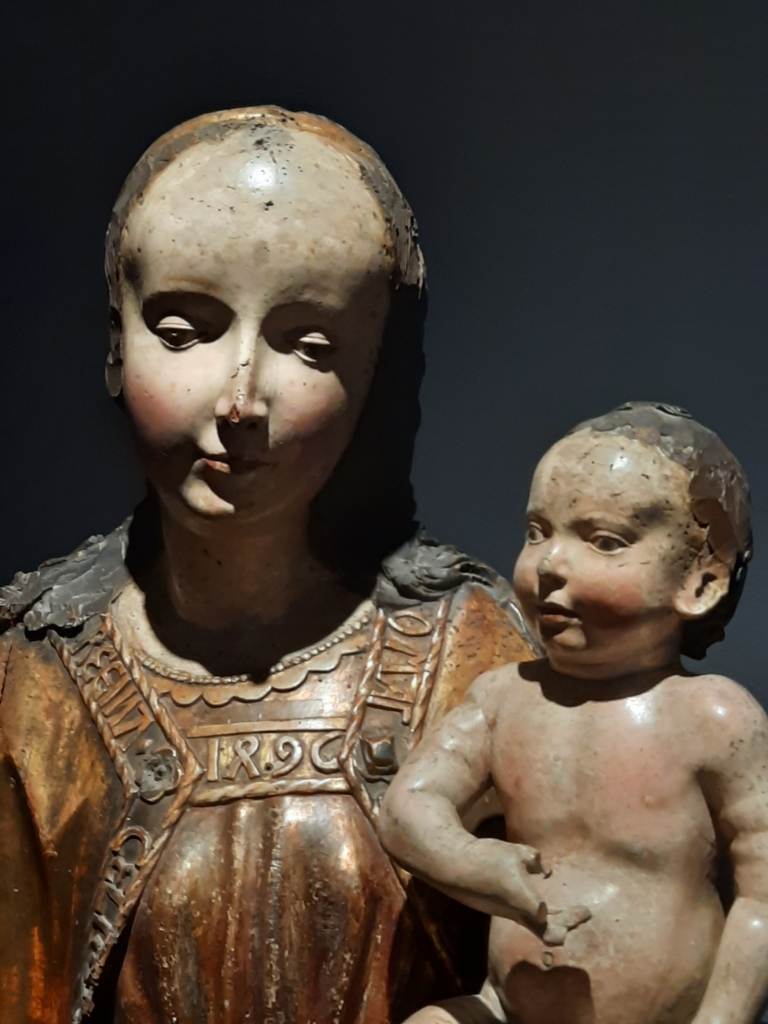
„An extraordinarily rich collection of portraits of shaved women can be found in the National Museum in Warsaw.”
Reply
S. Majda writes (07/12/2021):
„An idea for life taken from the film 'Borat and the Tape…’:
’I want to be like Disney’s Snow White, sleeping until a prince arrives. We will have fairy-tale sex until I wake up.'”
Reply
S. Majda writes (15/12/2021):
„’Ladies’ tailor’ is a good term for someone who, in the astral realm, sews together torn female genitalia. Surgery in this area is not a modern invention. Usually such work is performed by friendly or enslaved gay men, because hardly anyone else could endure it. It is worth connecting this information with the article 'Moles, Those Female Lures.'”
Reply
S. Majda writes (30/11/2022):
„Infibulation, also known as 'Pharaonic circumcision,’ has affected several African women now living in Poland. In Africa it has affected many more. It is possible that families perform such procedures on women believed to be karmic nymphomaniacs, either at the request of their souls or because they remember problems attributed to them in previous incarnations, seeking to suppress their sexual drives at the source.”
Reply
S. Majda writes (15/02/2024):
„The fur industry lobby and the anti-fur lobby were in conflict even within Parliament around 2020. The weekly magazine 'Nie’ still occasionally mentions this.”
Opublikowano: 18/06/2026
Autor: Sławomir Majda
Kateogrie: The Prostitute and the Soldier [PTSD, Combat Shock]
Komentarze